






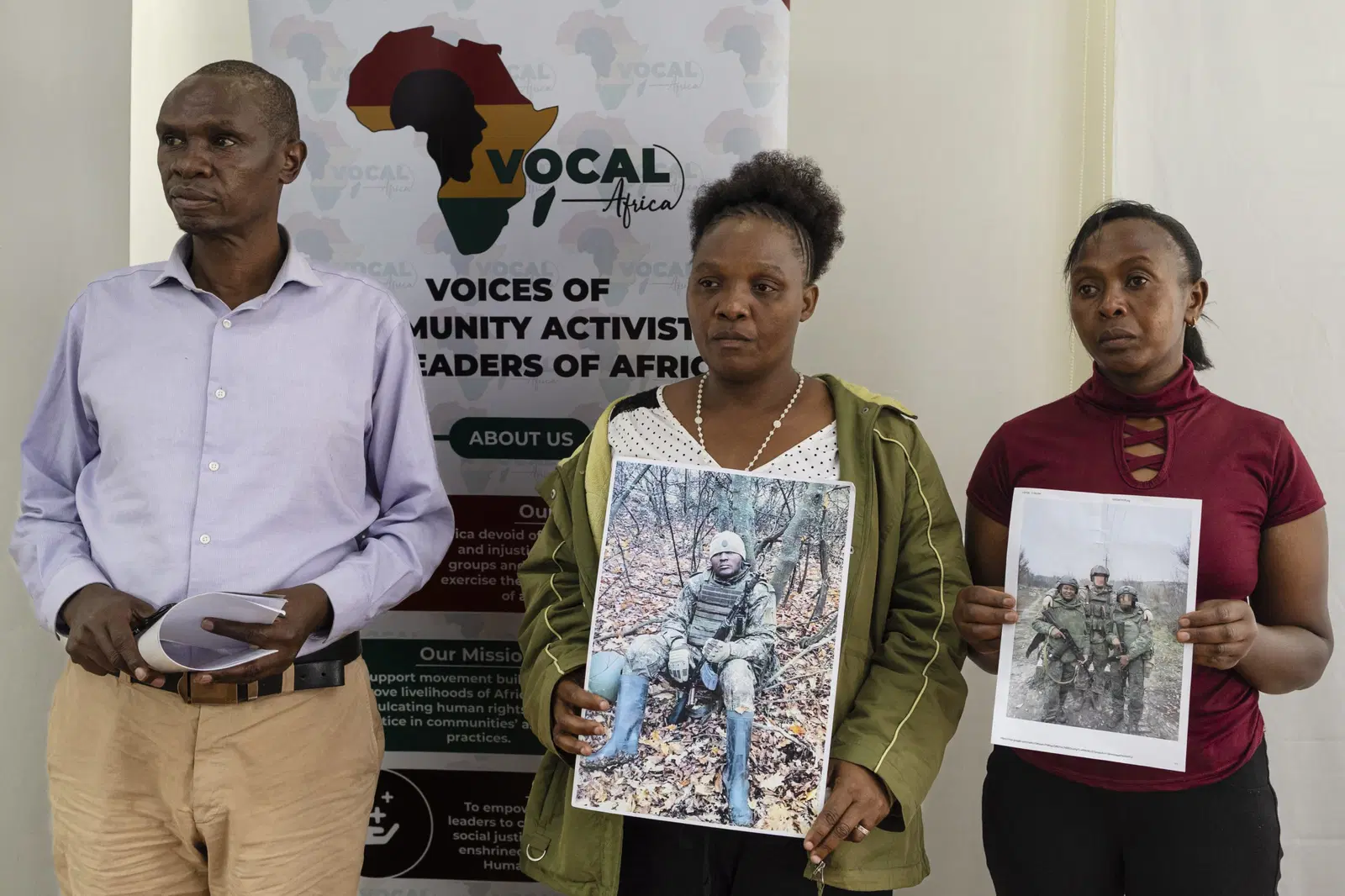

Victor’s forearm scars serve as a constant reminder of the day he was forcibly drafted into the Russian army, along with hundreds of other young Kenyans, and was hit by a Ukrainian drone.
He was extremely fortunate to have survived a conflict that had nothing to do with him.
Four Kenyans, Victor, Mark, Erik, and Moses, told AFP about the network of lies that led them to the Ukrainian death fields. For fear of retaliation, they have altered their names.
It started when a Nairobi employment agency promised well-paying positions in Russia.
The 28-year-old Victor was expected to work as a salesman.
Moses, 27, and Mark, 32, were advertised as security guards.
The 37-year-old Erik thought he had a pass to elite sports.
They were all expected to earn between $1,000 and $3,000 a month, which is a substantial sum of money in Kenya, where employment is scarce and emigration is encouraged by the government to boost remittances.
Victor, Mark, Erik, and Moses joined WhatsApp groups where other Kenyans assured them in Swahili that they would be going to interesting new places with good salaries.
Instead, Victor stayed in an abandoned house for three hours on his first day outside of Saint-Petersburg.
He was brought to a Russian military installation the following day, when he was given a contract in Russian that he was unable to read by the soldiers.
“If you don’t sign, you’re dead,” they informed us. Victor told AFP while displaying his combat medallion and Russian military service record.
Victor would eventually visit several of the Kenyans from the WhatsApp group in a military hospital, where they discussed “exciting opportunities.”
A few lacked legs. Some people had lost an arm. They warned me that if they posted a critical comment on the group, they would be killed,” he stated.
According to Mark, prospective recruits were given the opportunity to pay $4,000, which is an impossibly high amount, to get home.
“We were forced to sign the contract,” he stated.
Erik signed a contract that he thought would get him a professional club, and on his first day, he was training with a basketball squad.
He was unaware that it was a military contract in reality.
He was in an army camp the following day.
According to Mark and Moses, they received virtually little compensation for their year of work. Erik and Victor claim they didn’t get anything.
“Let our HR wizards connect you to exciting opportunities,” says the website of Global Face Human Resources, a Kenyan recruitment firm that arranged the four men’s departure for Russia.
The agency, which has moved multiple times in the last few months within Nairobi, the capital of Kenya, was not available for comment.
Following a police raid on an apartment he rented on the outskirts of the city in September, one of its employees, Edward Gituku, is facing charges of “human trafficking.”
The raid saved 21 young guys who were set to board a plane for Russia.
According to his attorney Alex Kubu, Gituku, who was freed on bond, disputes the accusations, AFP said.
Clinics:
Gituku was a major participant in the hoax, according to Victor, Mark, Erik, and Moses, who all claim to have met him.
Gituku even drove them to the airport in Nairobi, according to Erik and Moses.
Global Face Human Resources had transported “more than 1,000 people” to Russia, according to Gituku’s former attorney Dunston Omari, who told Citizen TV in September that all of them were former Kenyan soldiers who had “voluntarily” joined the Russian army.
According to Kenyan Foreign Secretary Abraham Korir Sing’Oei, who spoke to AFP at the time, Russian national Mikhail Lyapin, who was involved in the case, was removed from Kenya “to stand trial in Russia” at the request of the Russian government.
According to a press release from the Russian embassy in Kenya, Lyapin had “never been an employee of Russian governmental bodies” and had left Kenya willingly. AFP’s emailed inquiries were not answered.
In December, Kenyan authorities said around 200 citizens had been sent to fight in Ukraine, with 23 since repatriated.
According to the four recruits who spoke to AFP, this is an underestimation.
Before departing, prospective migrants to Russia had to go through a medical test, and one of several Nairobi clinics told AFP that they saw 157 patients in just over a month last year.
According to a clinic employee, “the majority were former Kenyan soldiers” who were aware of what was in store for them in Russia.
Mark and Erik, who were screened at the clinic, claimed they were never told they would be joining the military, despite tales of real Kenyan mercenaries fighting for Russia in Ukraine.
Victor and Moses went through Universal Trends Medical and Diagnostic Centre in Nairobi, which refused to provide AFP with information regarding the number of people recommended by Global Face Human Resources.
Although it was unable to get in touch with them, AFP was able to locate two further recruitment firms that were sending Kenyans to Russia.
According to a source close to the Russian embassy in neighboring Uganda, Festus Omwamba, the founder of Global Face Human Resources, made multiple trips there last year, AFP said.
AFP calls were banned by Omwamba.
Russia was accused of employing its own ethnic minorities, namely Chechens and Dagestanis, as expendable forces in the early stages of its invasion of Ukraine.
Its strategy was to overwhelm Ukrainian defenses by launching large troops upon them.
But there has been a significant human cost. According to Western intelligence services, Russia has lost twice as many people as Ukraine—more than 1.2 million.
This has forced Moscow to look farther for recruits.
According to Yurii Tokar, Ukraine’s ambassador to Kenya, Russia first targeted Central Asian former Soviet countries before moving on to India and Nepal before focusing on Africa.
According to the four returnees who spoke to AFP, they came across scores of Africans from South Africa, Nigeria, Cameroon, and Egypt in training camps and on the battlefield.
According to Tokar, Russia takes advantage of young Africans’ “economic desperation.”
“They are searching everywhere they can for cannon fodder,” he stated.
Victor describes terrible images along the front line in the Donbas, close to Vovchansk.
Many dead bodies were floating in the two rivers we had to cross. Then there was a large field with hundreds of bodies on it. To get across it, we had to run. “There are drones everywhere,” he remarked.
He stated, “The commander warns you not to try to flee or we will shoot you.”
Two of his unit’s 27 members crossed the field.
Victor was struck by drone fire in his right forearm but managed to live by hiding beneath a corpse.
He was permitted to receive medical care behind the lines after two more weeks of missions, during which he was unable to carry his rifle and maggots were crawling in his wound.
The Russian army dispatched Erik to the same spot a few weeks later without altering its plan, even though they had already sustained significant losses.
Only three of the 24 men in his operation survived; Erik, a Russian who had “his stomach ripped open,” and a Pakistani who ended up with “both legs broken.”
The 37-year-old claims that after miraculously escape this ordeal unharmed, drones struck him in the arm and leg.
Mark’s shoulder is scarred from a grenade that a Ukrainian drone threw while he was traveling to the front in September. The phrase “Destroyed my life” describes it. He is unsure about his location.
After a while, the three ended up in a hospital in Moscow and fled to the Kenyan embassy, which assisted them in getting back home.
In December, Moses was able to break out of his facility and communicate with Kenyan authorities.
He is just as traumatized as the rest, while being physically unharmed. He claims that a soaring bird is now sufficient to make him anxious.
They are aware that a lot of families in Kenya are facing more difficulties.
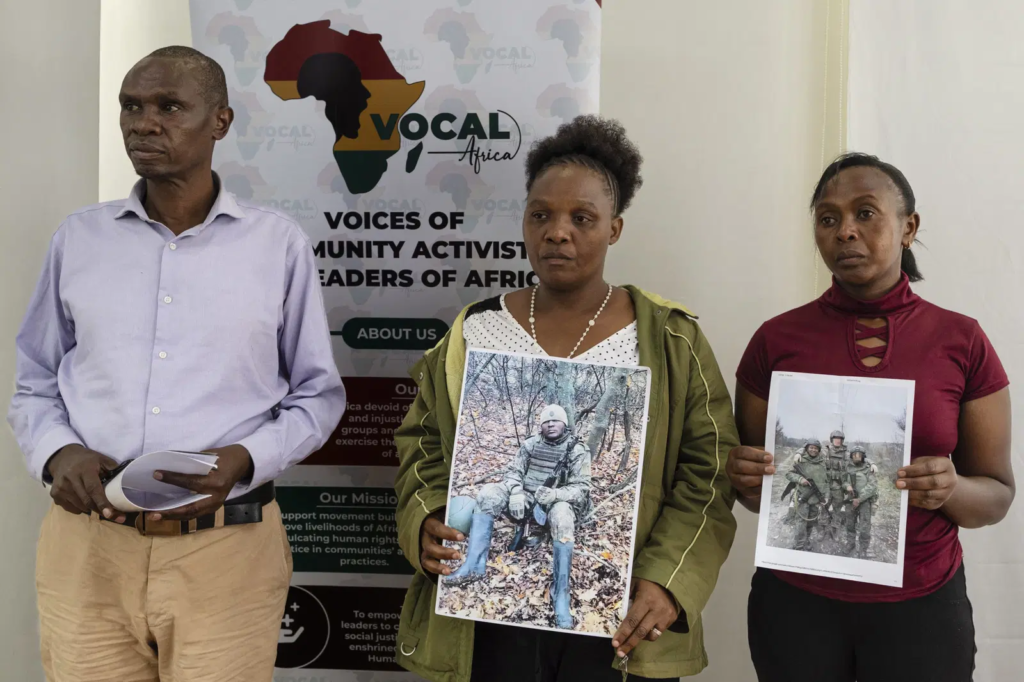
In November, Grace Gathoni, a single mother of four, found out that her husband, Martin, had been killed in battle while pursuing a career as a driver in Russia.
She sobbed as she told AFP that Moscow had “destroyed my life.”
The 72-year-old Charles Ojiambo Mutoka found out in January that his son Oscar had been murdered in August. Rostov-on-Don is where his remains are interred.
He passionately declared that the Russian government “should be ashamed.”
“Why take our people when we only fight our own wars and never send Russians to fight for us?”