






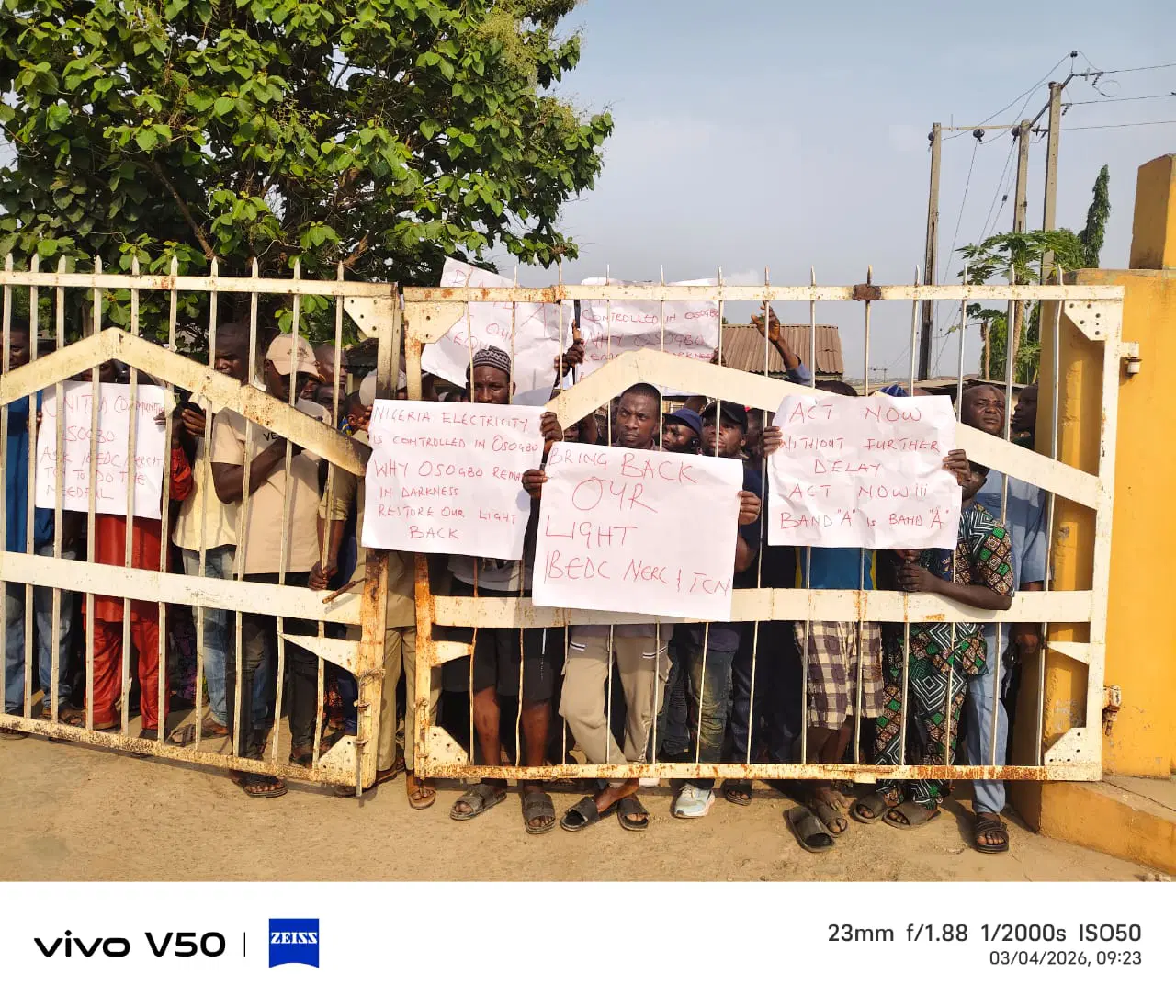

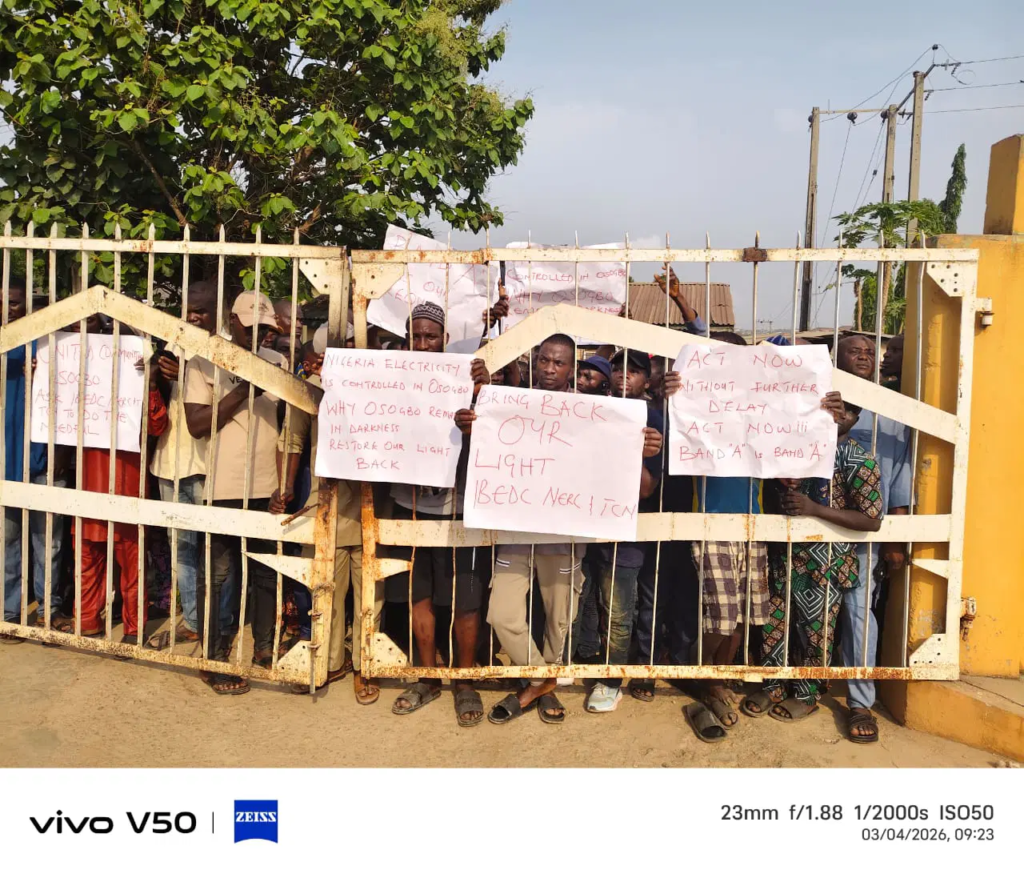
On Tuesday, business operations at the Ibadan Electricity Distribution Company’s (IBEDC) regional headquarters in Osogbo were interrupted by irate locals protesting what they called the Osun State capital’s “persistent epileptic power supply.”
After gathering at the Oke-Baale roundabout, the irate locals from Owo-Eba, Ilesa-Garage, Tara, Oke-Baale axis, OSBC Area, UNIOSUN axis, Akede, Air Force Base, Army Depot, Boredun, Coker, Odu, and Omu marched almost three kilometers to the IBEDC regional office on Station Road.
With signs that read, “We can’t be paying for darkness,” “Our businesses are dying,” and “Bring back our light,” the demonstrators called for an urgent change in the availability of energy.
Speaking to IBEDC representatives on behalf of the demonstrators, Mr. Badmus Akeem claimed that after the impacted areas were demoted from Band A to Band C, the situation got worse.
In contrast to the minimum 12 hours required under the band classification scheme, he claimed that residents had struggled to receive up to four hours of electricity every day since the reclassification.
“This epileptic power supply has had a disastrous effect. According to Akeem, “corporate institutions are severely impacted, small-scale businesses are on the verge of collapse, and residents are experiencing severe hardship.”
He listed the Osun State Broadcasting Corporation as one of the impacted organizations, claiming that the insufficient electricity supply has caused it to transmit for less than six hours every day.
The demonstrators urged IBEDC to immediately address the supply gap in accordance with the required minimum hours per band and asked that all villages under their jurisdiction be returned to Band A within seven days.
They threatened to take legal collective action, such as reevaluating IBEDC employees’ operating access in the impacted locations, if the demand was not met within the ultimatum period.
In response, Mr. Ifeanyi Ikeji, Regional Manager of IBEDC, stated that although the business was open to returning the communities to Band A, it would not make the choice hastily without first addressing supply-related generation issues.
He clarified that electricity generating issues affected consumers on Band A, which he referred to as the company’s most promising category, nationwide.
Ikeji urged locals to promote meter purchase in order to satisfy the 90% metering requirement for Band A users, citing the large number of unmetered customers as an additional barrier.
He gave the demonstrators his word that the business will keep working with stakeholders to find a long-term solution to the problems with the power supply.