






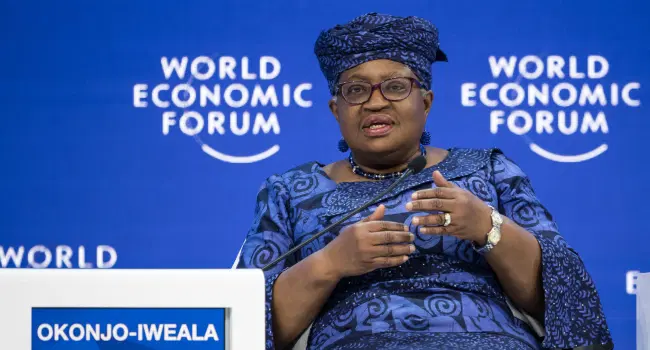
Dr. Ngozi Okonjo-Iweala, the Director-General of the World Trade Organization (WTO), has called on the Nigerian government to actively court foreign investors and put the nation in a position to profit from continuous supply chain relocations in order to lessen reliance on imports, strengthen domestic manufacturing, and generate employment.
During a panel discussion titled “From Scale to Capital: Financing Nigeria’s Role as Africa’s Digital Trade and Infrastructure Anchor,” Okonjo-Iweala made the request on Wednesday at Nigeria House on the fringes of the World Economic Forum in Davos, Switzerland.
Rising geopolitical tensions, especially between the US and China, have spurred global supply chain diversification, according to the WTO chairman, opening doors for nations like Nigeria.
“Although China is still deeply ingrained in many global value chains, companies are increasingly implementing China+1 sourcing strategies to reduce single-country risk,” she stated.
“Tariffs and trade restrictions have also encouraged businesses to reevaluate their reliance on dominant suppliers, leading to the relocation or diversification of production hubs.”
She claims that if Nigeria actively offers itself to potential investors, these changes offer a chance for the nation to gain a piece of the world’s industrial and production networks.
While acknowledging Nigeria’s current changes, Okonjo-Iweala emphasized the necessity of converting them into job possibilities.
“Some positive measures are currently being undertaken, as you mentioned. They should give way to the creation of jobs, in my opinion,” she stated. “We need to shift from stabilization to job creation because that is where we are lacking,” I told His Excellency.
Nigeria was “moving in the right direction,” she said, adding that authorities must find and seize certain possibilities even though the process would not provide results immediately away.
“If there is one thing I would say, it is that we should do everything in our power to present Nigeria as a nation deserving of investment.”
Okonjo-Iweala stated, “I would like to see a continued effort to attract investment into the country because there is an opportunity to attract these supply chains.”
She called on the government to actively seek out possible investors in all of the world’s major economies.
She stated, “We should consciously have strategies to go after those investments and investors—to go to China, the US, whatever it takes—to come and invest in our country.”
Nigeria should try to draw in “a sizeable chunk” of the movement, she added, pointing out that a large portion of the present diversification from China is still in Asia, with India emerging as a key destination.
Okonjo-Iweala identified pharmaceuticals, textiles, and renewable energy as important industries Nigeria may pursue.
“Let’s construct solar panels in Nigeria.” Although we can manufacture, we also import. “We possess the capacity for renewable energy,” she stated. “Let them come invest in fashion. To succeed domestically rather than abroad, let’s draw in investment.
“There is a chance there as well,” she continued, adding that drugs also offer a significant opportunity. I would be attracting some of these supplier chains.