







As part of Governor Peter Mbah’s larger vision for economic development, the Enugu State Government has promised extensive reforms in the land sector, including the immediate elimination of unlawful levies and the simplification of land-related charges.
Regardless of whether their properties are located inside or outside of estates, property owners are now only required to pay a single Unified Land Use Charge annually through the Enugu State Internal Revenue Service (EIRS). The government revealed that ground rent, land use charge, and all other property-related charges have been unified and reduced by more than 60%.
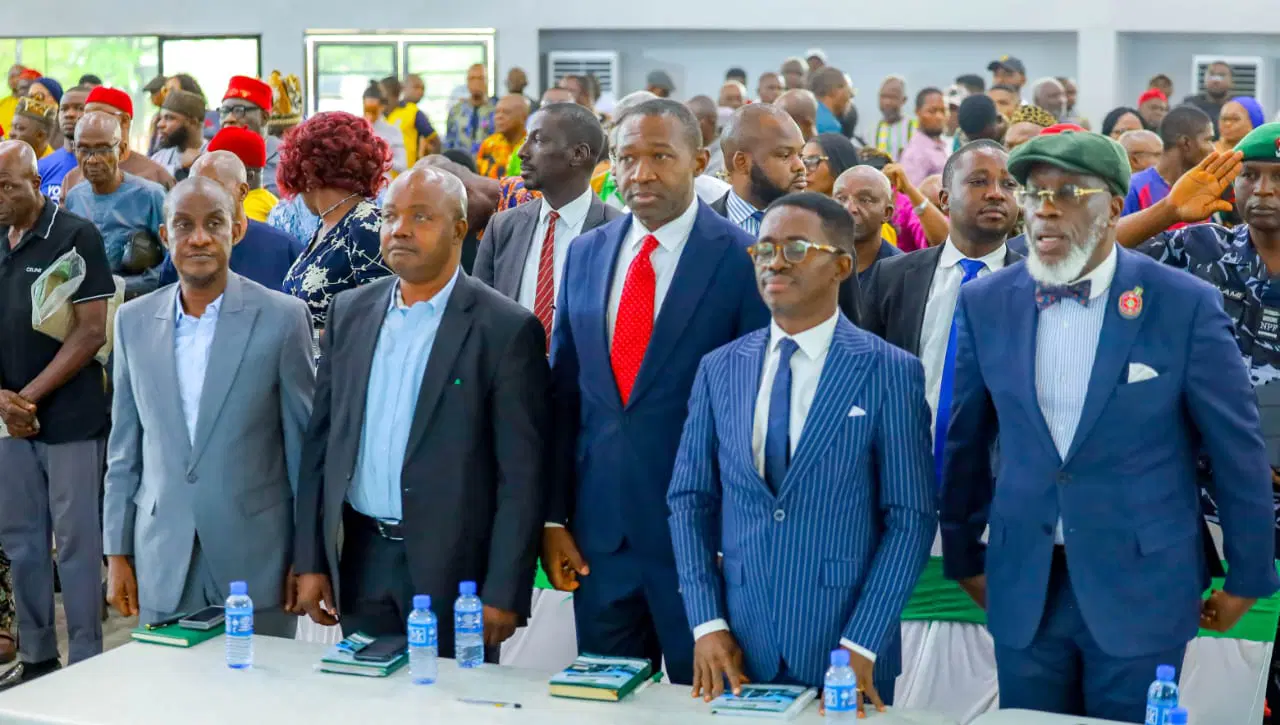
At a town hall meeting on land sector development for stakeholders on Thursday at the International Conference Center in Enugu, Governor Peter Mbah made the announcement.
The Governor, represented by Prof. Chidiebere Onyia, Secretary to the State Government (SSG), stated that his administration was still dedicated to creating an open, effective, and investor-friendly land administration system based on accountability, digitization, and legality.
He explained that land is the legal basis for housing, infrastructure, agriculture, commerce, and investment. He emphasized that the administration has worked to modernize land governance, lower uncertainty, stop abuse, and rebuild public trust in the land tenure system since its founding.
“These reforms are anchored on transparency, predictability, digitization of records, and strict adherence to statutory processes for land allocation, registration, and development control,” he stated. He added that ongoing engagement with communities, professionals, investors, traditional institutions, and citizens is necessary for effective land governance.
The immediate prohibition of the contentious Ogbonecheagu fees collected by certain local governments and communities is a significant feature of the reforms. Prof. Onyia stated that in response to several complaints from locals, Governor Mbah has declared all such fees unlawful and ordered their complete elimination.
Members of the public who are forced to pay such unlawful charges are encouraged to provide proof to Whistleblowing@enugustate.gov.ng for rapid assistance, and a task force has been established to enforce compliance.
The SSG further disclosed that the suggestions of a multi-stakeholder Committee on Land-Related Revenue and Administration, which was established by the governor to address issues of multiple taxes and revenue misuse in the state, served as the basis for the reforms.
Barr, the Commissioner for Lands and Urban Development, made these comments. Chimaobi Okorie, said Governor Mbah has implemented crucial policy directions and legal tools, including an executive order classifying nine of the state’s seventeen local government districts as urban regions to facilitate planning and organized infrastructural development.
Additionally, he stated that the Enugu State Geographic Information System (ENGIS) law was passed by the Mbah Administration in order to facilitate land transactions and promote the complete digitization of land systems and processes. He claims that every piece of land in the state can be digitally traced and that land records are now completely harmonized, removing instances of missing information.
Applicants for Certificates of Occupancy (C of O) can now apply online or in person at specific government locations for quick processing, the Commissioner continued. He added that the Property Protection Law, which Governor Mbah signed, safeguards investors’ investments and ensures the security of lawful property ownership.
During his presentation, Mr. Chiwetalu Nwatu, the Managing Director of ENGIS, declared that all buildings, regardless of location, that are situated in housing estates owned by the Ministry of Housing and the Housing Development Corporation must now obtain building approval directly from the Ministry and the Corporation.
In order to avoid jurisdictional overlaps and administrative delays, he continued, the Enugu Capital Territory Development Authority (ECTDA) will now handle building approval for homes in non-government estates within the Enugu municipal area entirely.
Mr. Nwatu further said that all buildings in government and private estates will now have their Certificates of Occupancy handled directly for individual property owners, enhancing asset bankability and title security.
Speaking as well, Mr. Emmanuel Ekene Nnamani, Executive Chairman of the Enugu State Internal Revenue Service (ES-IRS), stated that the recently enacted Tax Law was intended to safeguard low-income earners while imposing a higher tax burden on the wealthy.
In order for the government to produce reliable data for development planning, he urged citizens to comply with tax filing regulations and receive their Tax Identification Numbers at no cost.
Responding to inquiries from stakeholders, Prof. Onyia announced the establishment of a committee chaired by the Managing Director of ENGIS, Mr. Chiwetalu Nwatu, to address grievances relating to layouts and offer practical remedies within one week for government consideration.
A wide range of stakeholders, including heads of government agencies, community landowners, estate developers, surveyors, town planners, property agents and lawyers, traditional rulers, town unions, business operators, religious organizations, financial institutions, civil society groups, development partners, and members of the public, attended the town hall meeting.