






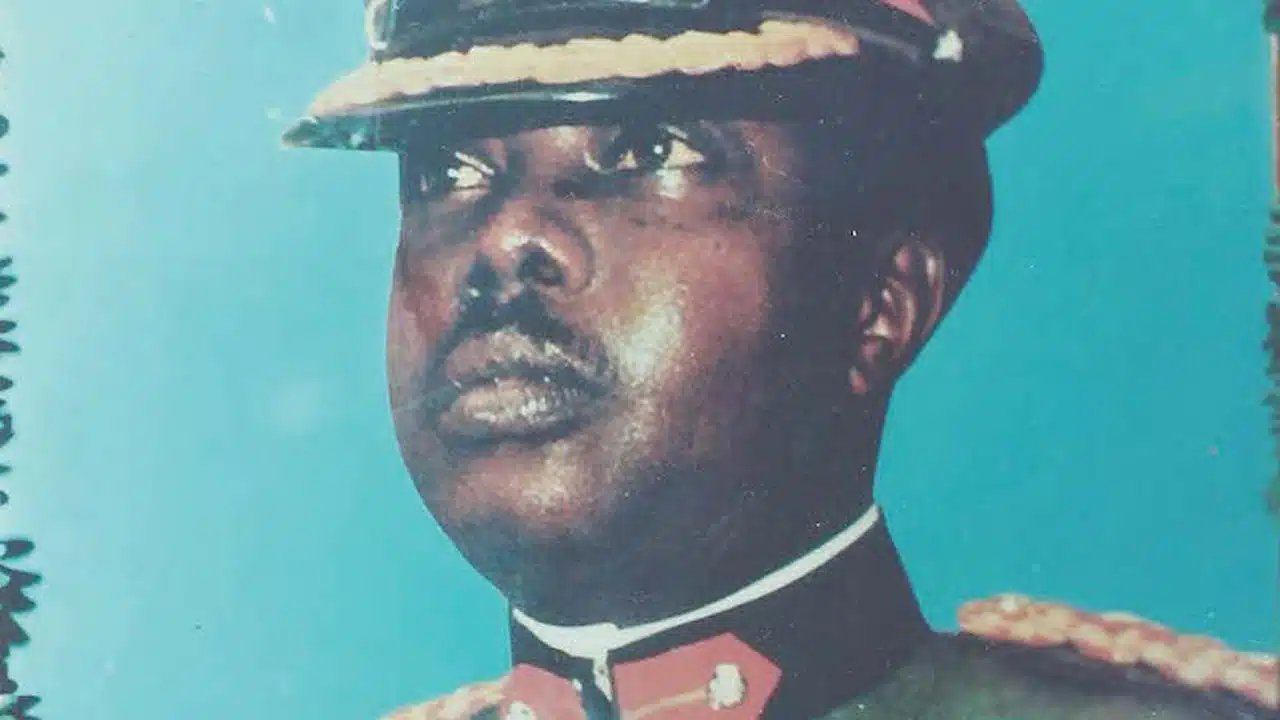


The emotive memory of his former orderly, Michael Otuwe (retd.), who witnessed the failed 1976 coup firsthand, has brought up new emotions fifty years after the assassination of former Head of State Murtala Muhammed.
The retired soldier describes his experiences during the civil war, the personal sacrifices that characterized years of close service to one of Nigeria’s most revered military figures, and how the charismatic leader nearly escaped his assailants in a rare interview that was done ten years ago and is being re-examined to commemorate the anniversary.
In the interview with Daily Trust, Otuwe recounted his experience joining the military, saying, “I am an Igala man from Olamoboro Local Government of Kogi State.” Prior to enlisting in the army, which is the career I most admired, I attended Ankpa Primary School and Ankpa Model Secondary School.
He claims that on the eve of the Nigerian Civil War, on September 11, 1967, he joined the Nigerian Army in the Ikeja Military Cantonment in Lagos, where he received six months of training.
“I was assigned to the Nigerian Army Signal Corps after the training, and by the way, Murtala Ramat Mohammed was the Inspector of Signals at the time and a Colonel,” he continued.
According to Otuwe, Muhammad personally selected him due to his neatness and discipline.
He informed me that during our master parade, he observed how spotless I was in my army uniform. When I was a Lance Corporal, he chose me to be his orderly,” he said.
He clarified that he worked closely with Muhammad over a number of assignments, including the civil war, when the late general was appointed the Nigerian Army’s first General Officer Commanding of the Second Division.
Otuwe stated, “I worked with him until he was killed, which was 11 years,” adding that the General had three children during that time: Aisha, Zakari, and Fatima.
Muhammad was characterized by Otuwe as a strategic and well-behaved military leader.
He organized men and their well-being. He was intelligent, diligent, and prioritized Nigeria above all else, he claimed.
He remembered a time when they were surrounded by Biafran soldiers.
Even those of us with him were perplexed by his brilliant tactical move and retreat. He set out to battle and win so that Nigeria might remain a united nation while many wanted to give up.
Getting Through Ambushes
The retired soldier described a number of ambushes that occurred throughout the conflict. He claimed that although there were numerous ambushes and attacks, being surrounded at Ukpo Junction in Abbagana stands out as one of the most unforgettable. Murtala made a calculated move by withdrawing and getting ready for a defensive assault, which resulted in the conquest of numerous towns and cities.
Following several operations, troops traveled through Asaba and then to Idah in modern-day Kogi State to be ready for more offensives, Otuwe continued.
General Murtala returned to Lagos in 1968 as the Minister of Communications and Inspector of Signals after a reorganization. He claimed that this implied he was working two jobs at once.
Otuwe discussed the impact his work had on his family, stating that his wife had become accustomed to life in the military.
She had assimilated into the system and was married to a soldier. She assumed we were off duty when she spotted us at home,” he stated.
He stated that because of his hectic schedule, his kids didn’t see him very often.
Otuwe observed, “I left home at dawn and returned late at night, so most of my children nearly forgot me.”
Covert Visits and Price Tracking
Additionally, Otuwe described how Muhammad pretended to be someone else in order to keep an eye on Lagos market pricing.
He remarked, “I once followed him to survey prices and the rising cost of goods with his ADC, Lieutenant Akintunde Akinterinwa.”
He rode a horse to a fueling station, disembarked, tied it, and entered Sangross (Lagos Island), Ajegunle, and subsequently Agege markets while wearing a tracksuit, a face cap, and dark goggles. I pretended to be a window shopper while the ADC wrote the prices and acted as though we were not together. Since everyone was waiting for their time and people were more disciplined back then, a market woman advised him to give other buyers a chance. Meat and commodities arrived in ships after two weeks. The meat was labeled “Murtala Meat.”
The Assassination Day
“He was assassinated on July 29, 1976,” Otuwe recounted when asked what transpired on the day of Murtala’s murder (Starts sobbing tears). From July 29, 1975, to February 13, 1976, he held the position for six months. He was a very decent man since he made sure that General Gowon’s personal belongings were carefully removed rather than thrown out and that the residence was refurbished before he left Dodan Barracks. For this reason, he was traveling from Ikoyi without the use of pilot vehicles, motorcycles, armed military personnel, or security escorts.others. With the national flag on the left and the military flag on the right, he exclusively drove the official Mercedes-Benz. We went through the Federal Secretariat in Ikoyi on that fateful day, which was coated in zinc and undergoing renovations.
“The traffic man did not see the flags when we arrived at Alagbgon Junction, and he would have let the cars going our way continue, but instead he stopped the five or six cars ahead of us. Then I noticed some people in Agbada (Babanriga), and when they raised them, they pulled out AK-47 rifles and opened fire on us.” Sergeant Adamu Michika, the driver, had already been struck in the head by a masked man who felt on the armrest where the suit bag with the General’s mufti was located. I landed on the driver after taking cover.
Both the ADC and the General sought refuge. One of the Majors noticed that as the ADC opened the door to assist the General, the Major shouted and informed his colleagues that they were still alive. This occurred after the assassins had left and were on their way to the National Broadcasting Corporation, Radio House, to announce the takeover. They turned, hurried back, and fired their weapons at us as a result. I was shot in the hip and arm, and I was the only one who survived.
“General Murtala’s loyalist troops pursued the soldiers and led us to the mortuary.” When the discomfort and the air conditioner’s breeze awakened me up, I came out of my coma. A mortuary attendant noticed that I raised my hand, and he alerted a doctor, who said I was alive, and they took me to Dodan Barracks and then to a hospital on Awolowo Road, Ikoyi.”
“I spent six months recovering and resumed work with the Nigerian Army Signal Corps,” Otuwe remarked in reference to his recuperation from the incident. Generals Adenaju, Raji Rasaki, and Tanko Ayuba were my coworkers there.
The former soldier said, “No, not at all,” when asked if he had ever been honored.
“I am currently staying in a rented two-bedroom house in Maraba in Nasarawa State,” Otuwe disclosed when discussing his place of abode at the time of the interview. There is no name for the street, let alone a house number. However, I work at Riskua Murtala Muhammad’s Maitama office.
Otuwe stated that on December 31, 1999, he retired from the military as a Master Warrant Officer.
Otuwe responded, “No, no, no, not at all,” when asked if he had ever regretted becoming a member of the Nigerian Army.