






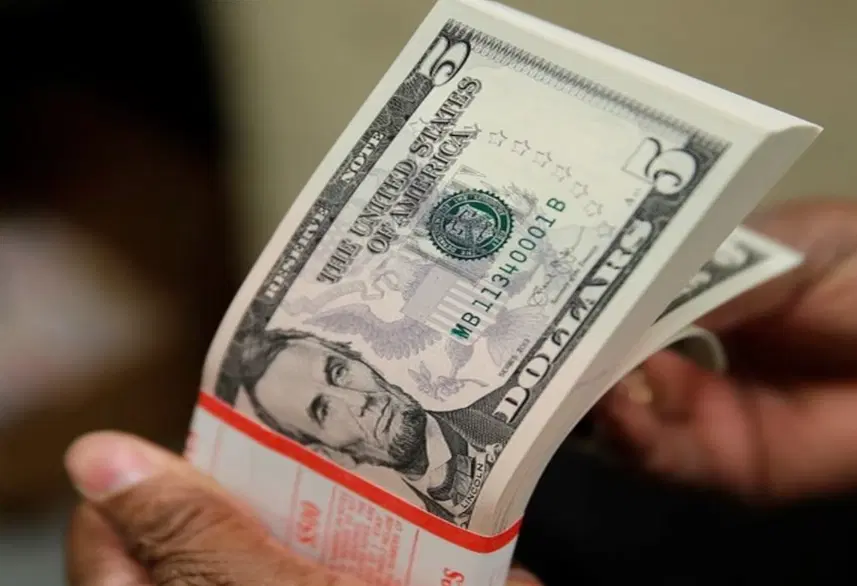

While stocks began the week on a mixed note, the dollar declined in Asian trade on Monday amid rumors that US officials would join their Japanese counterparts to boost the yen following a recent sell-off.
According to Bloomberg, the Japanese yen surged more than one percent to 153.89 per dollar, its best level since November, following reports that the Federal Reserve Bank of New York had checked in with dealers over the yen’s exchange rate.
Concerns about Japan’s fiscal situation, the central bank’s decision to refrain from raising interest rates further, and predictions that the US Fed may postpone lowering its own borrowing costs this week have all contributed to the yen’s decline.
When it hit 160 to the US dollar in 2024, Japanese officials last intervened to stabilize their unit.
The possibility of government intervention in financial markets caused the dollar to decline overall, while the Singapore dollar reached an 11-year high and the euro, pound, and South Korean won all witnessed significant increases.
As a result, gold prices increased by more than 2% and broke $5,000 for the first time.
Tokyo “will continue responding appropriately against FX moves, working closely with US authorities as needed, in line with the joint statement issued by the Japanese and US finance ministers last September,” according to top currency official Atsushi Mimura, who stoked talk of joint intervention on Monday.
His comments were made one day after Sanae Takaichi, the prime minister of Japan, issued a warning, saying, “We will take all necessary measures to address speculative and highly abnormal movements.”
“Early Asia saw the dollar pushed lower as rate-check chatter swirled around the Fed, and intervention-tinged language out of Tokyo reminded the market that yen weakness is no longer a free carry,” stated Stephen Innes of SPI Asset Management.
“The yen’s surge in early Asian liquidity was sufficient to push the broader dollar back into the Asia open.”
Focus on the Fed meeting
“The balance of risks may point toward dollar vulnerability and heightened two-way volatility in USD/JPY as markets navigate intervention uncertainty and evolving policy expectations around BoJ policy stance and Japan Prime Minister Takaichi’s fiscal policy,” stated Lloyd Chan of MUFG.
Gold reached a peak of $5,111.07 per ounce thanks in part to the declining value of the dollar. Silver surged beyond $109 on Monday after breaking $100 on Friday.
Due to a rush into safe havens by traders alarmed by growing geopolitical concerns, such as Donald Trump’s intervention in Venezuela and a recent warning to Iran, precious metals have recently broken numerous records.
Fresh concerns about another US government shutdown have been added to the mix, along with strong central bank demand and high inflation.
“Gold’s price action over the past few days has been textbook safe-haven behavior,” stated Forex.com market expert Fawad Razaqzada.
“There is still a fundamental need for protection. Bond and currency confidence appears to be a little wobbly.
The most recent events coincide with the Fed’s upcoming policy meeting this week, where policymakers are anticipated to maintain current rates after lowering them in the previous three.
“We don’t anticipate learning much at the FOMC meeting in January. The Fed is still relying on data but is on hold. In reference to the bank’s objective of maintaining a ceiling on inflation and bolstering the labor market, Bank of America economists stated, “The balance of risks around the two mandates hasn’t changed much since December.”
Questions regarding politics rather than policy may predominate during Chair Powell’s press conference. However, market pricing on the latter raises the possibility of a dovish surprise.
Trump has openly expressed his contempt for Powell, asserting that there is “no inflation” and frequently casting doubt on the Fed chair’s skill and morality.
Wall Street’s weak lead on Friday caused equity markets to falter.
The rising currency, which hurts Japanese exporters, caused Tokyo to drop 1.8%. Shanghai, Singapore, Seoul, Manila, and Bangkok also saw declines.
Wellington, Taipei, and Hong Kong all rose.
Frankfurt was flat, Paris collapsed, and London got off to a fast start.
Following Trump’s announcement that a US “armada” was moving toward the Gulf and that Washington was keeping a close eye on Iran, oil prices continued to rise by about three percent on Friday.
Following Washington’s support and participation in Israel’s 12-day war in June to undermine Iran’s nuclear and ballistic missile programs, the president has repeatedly hinted at the possibility of further military action against Tehran.
Key data at approximately 08:15 GMT: Dollar/yen: DOWN at 154.20 yen from Friday’s 157.00 yen
Euro/dollar: increased from $1.1823 to $1.1845
Pound to dollar: increased from $1.3636 to $1.3650
Euro/pound: increased from 86.70 pence to 86.76 pence
Tokyo’s Nikkei 225 closed at 52,885.25, down 1.8%.
Hong Kong’s Hang Seng Index closed at 26,765.52, up 0.1 percent.
Shanghai Composite: Closed at 4,132.61, down 0.1 percent
London’s FTSE 100 is up 0.2 percent at 10,162.02
West Texas Intermediate: $61.11 per barrel, up 0.1%.
Brent North Sea Crude: $65.93 per barrel, up 0.1%.
New York: Dow: closed at 49,098.71, down 0.6%.
AFP