






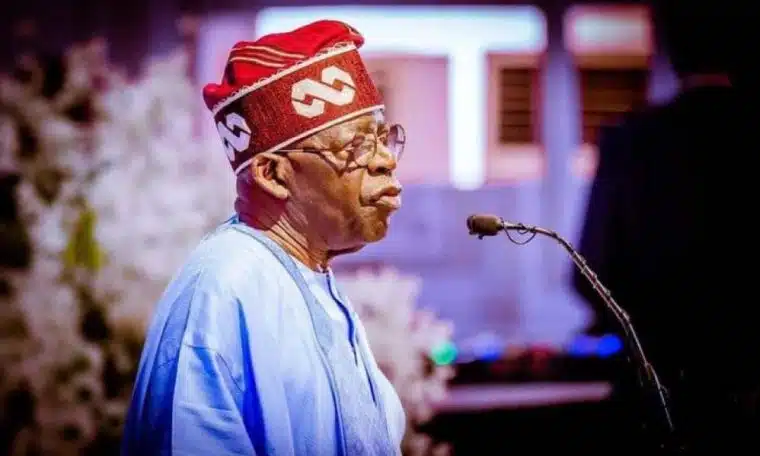
President Bola Tinubu has advised Nigerian journalists to put truth, accuracy and professional ethics over sensationalism and the growing desire of hits, likes and online interaction.
Naija News adds that the President addressed on Thursday at the maiden State House Media Dinner in Abuja, where he reaffirmed his administration’s commitment to press freedom but stressed that constitutional rights must be exercised with care.
Tinubu identified himself as a longstanding defender of a free press, stating that his view on media freedom had remained constant throughout his public life.
“I support a free press. I have defended and pushed for the rights of the media throughout my public life and will continue to do so,” he said.
The President stated that press freedom and freedom of expression should not be exploited to disseminate misleading information or purposefully deceive the public.
He contends that journalists have a need to correctly and thoroughly cover events, especially in a way that avoids escalating social tensions.
“While press freedom and free speech continue to be the cornerstones of an open and democratic society, journalists and citizens must also remember the imperative of balancing rights with responsibility and the duty you hold to society to report and inform with care and accuracy to facts and in a manner that ensures the society is not set on fire,” Tinubu stated.
He urged journalists to withstand pressure to put viral content and spectacular stories ahead of reliable reporting.
“The media ought to prioritize truth over lies. Substance must take precedence over sensation in the media. He continued, “The media must prioritize credibility over clickbait and the never-ending competition for followers, likes, and viral outrage.”
According to Tinubu, the proliferation of false information, disinformation, deepfakes, and artificial intelligence-generated content has made professional journalism even more crucial.
The President pointed out that people are depending more and more on qualified journalists to confirm facts and separate reliable reports from conjecture.
He stated, “The public depends on journalists not just to report events but to separate fact from fiction, truth from speculation, and evidence from opinion.”
“The responsibility of professional journalism has never been greater in a world where everyone with a smartphone is a journalist.”
Tinubu emphasized that the right to free speech should not be seen as authorization to purposefully spread false information or harm the reputation of others.
He asserts that press freedom “is not freedom to deliberately mislead” and that freedom of expression “is not freedom to defame.”
Speaking on the connection between government and the media, Tinubu portrayed both institutions as partners in nation-building, despite the inevitable tension between journalists and those in power.
Since the media consistently mistrusts people in positions of authority, we are only enemies in the democratic sense. We are partners in nation-building,” he declared.
“The purpose of government is to serve the people through public service, policy, and leadership. By keeping an eye on individuals in positions of authority, posing challenging queries, and holding the government responsible, the media serves society.
According to the President, conflict between the government and the media is both necessary and unavoidable in a functioning democracy.
“The government needs to take action. The media has to keep an eye on it. The government needs to provide an explanation. The media needs to ask questions. A certain amount of stress is guaranteed by that arrangement, he stated.
Additionally, the President supported current regulations governing internet activity, such as the Cybercrimes Act, arguing that they were meant to safeguard citizens rather than stifle journalists.
“The media industry is no longer an uncontrolled area. Tinubu stated, “Nigeria has passed laws, such as the Cybercrimes Act and other pertinent legislation, to protect citizens from malicious falsehoods, cyberstalking, identity theft, and other abuses that increasingly accompany the digital age.”
“Press freedom is not meant to be weakened by these protections. Rather, they exist to safeguard citizens and preserve the integrity of our information ecosystem.”
Tinubu maintains that “economic reforms are yielding results.”
Regarding the economy, Tinubu stated that his administration’s measures were starting to yield favorable outcomes.
“Our economy is beginning to stabilize. The strength of public revenues has increased dramatically. The amount allotted to state governments to promote development has increased significantly. Investor confidence is returning,” he said.
The President further stated that investment in the oil and gas industry was resuming, and Nigeria’s foreign reserves had improved.
He said that the administration’s fiscal and tax changes were also creating the groundwork for long-term economic expansion.
Tinubu: Thousands of terrorists have been neutralized
Regarding security, Tinubu stated that enhanced intelligence collection and increased cooperation between security agencies had enabled military operations to be stepped up in many theaters.
Thousands of terrorists and criminal elements have been eliminated as a result. Numerous captives have been rescued. Communities once under threat have been reclaimed,” he said.
Without sacrificing the press’s constitutional duty to hold public officials responsible, the President reaffirmed his appeal for increased cooperation between the government and the media.
“Let’s substitute productive involvement for unnecessary animosity. Let’s swap out sensationalism for professionalism. Tinubu declared, “Let us replace the pursuit of outrage with the pursuit of truth.”
“Together, let’s keep constructing a country where every Nigerian has reason to believe in the promise of our country, truth matters, accountability thrives, and democracy flourishes.”