






By Energy Editor Udeme Akpan
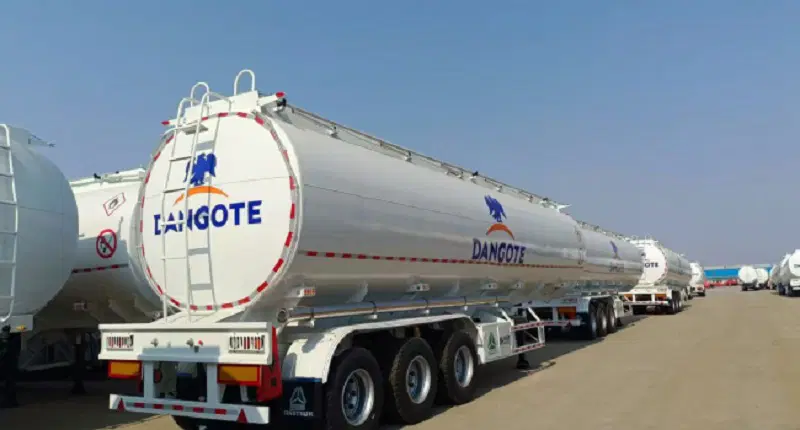
The Dangote Petroleum Refinery in Lagos, Nigeria, is the source of petroleum products that the Ghanaian government has promised to import.
This comes as the refinery, which produces 650,000 barrels per day, claims to have enough capacity to service both the domestic demand in Nigeria and the larger African market.
Godwin Kudzo Tameklo, the chief executive officer of Ghana’s National Petroleum Authority, stated that the nation’s two tiny refineries are unable to supply the country’s domestic fuel demand during a speech at the ongoing Nigerian International Energy Summit (NIES) in Abuja.
This, he said, explains why Ghana will keep importing refined petroleum products and crude oil from Nigeria.
Ghana and the Dangote Petroleum Refinery have already started working together to build a solid business relationship, he continued.
Tameklo also emphasized the necessity of consistent regulation and stable macroeconomic conditions throughout Africa, pointing out that successful intra-African energy commerce depends on exchange-rate stability.
“As a nation, Ghana has attempted to run two large refineries and a modular refinery that produces roughly 5,000 to 6,000 barrels per day, which is quite small,” he stated.
In Ghana, a refinery with 6,000 barrels per day is seen as substantial, whereas in Nigeria, it is inconsequential. Both refined goods and crude oil have always been imported. For the Dangote Refinery, Ghana thus constitutes a robust offtake market.
“We have had extensive engagements with Alhaji Aliko Dangote to position Ghana to take refined products from Nigeria,” he continued. Because Ghana and Nigeria are so close, we can lower the cost of fuel delivered to Ghana by relying more on Nigeria’s refined petroleum products.
“We are making every effort to strengthen that connection. However, consistent regulation and steady economic growth are necessary for this to be successful. The economic advantages for our people will be limited if the Ghanaian cedi is doing well while the naira is experiencing pressure.
According to Tameklo, the regulator’s main goal is to guarantee that consumers have access to reasonably priced, high-quality fuel.
Ensuring Ghanaians have access to more reasonably priced, high-quality items is our top priority as regulators. We can provide value to our people by working with refineries like Dangote, who have pledged to offer high-quality products,” he stated.
He pointed out that Ghana is prepared to offer Nigerian refined goods a ready market.
In terms of collaboration and market access, Nigeria can always count on Ghana. It’s safe to say that Nigeria has established itself as Africa’s energy center. He stated that in order to guarantee collaboration and mutual gain between Ghana and Nigeria, this stance should be reinforced by sensible regulation.
In addition, Tameklo warned that regulation pricing in downstream sectors may stifle competition.
In Ghana, merchants are not allowed to sell fuel below a certain minimum price. This is to safeguard the sector and stop actions that would drive out important participants. According to him, “allowing operators to sell below cost as a market-entry strategy can destroy competition.”
“In 2015, when the government was subsidizing gasoline and could not pay subsidies on time, fuel stations were collapsing,” he continued, using Ghana as an example. We completely deregulated pricing and let market forces work in order to prevent this. This has contributed to the development of a strong and resilient downstream industry.
We can service both domestic and international markets—GVP
Devakumar Edwin, Group Vice President (Oil and Gas) of the Dangote Group, stated in an interview with Vanguard that the refinery has enough capacity to satisfy both domestic and export demand.
“The refinery is currently operating at about 85% of its installed capacity of 650,000 barrels per day, with steady progress toward full utilization,” he stated.
“We manufacture Automotive Gas Oil (AGO), commonly referred to as diesel, and Premium Motor Spirit (PMS), commonly known as gasoline.”
According to Edwin, Nigeria only needs roughly half of the refinery’s output to satisfy all local demand.
To meet its needs for gasoline and diesel, Nigeria only needs around half of our production capacity. Significant amounts are still available for export, and export volumes will rise even more as a result of planned expansions, he stated.
He went on to say that the facility’s strength is demonstrated by the fact that some processing units are now running above design capacity.
According to Edwin, “this represents a major turnaround for Nigeria, considering that the country relied almost entirely on imported refined petroleum products for decades.”