






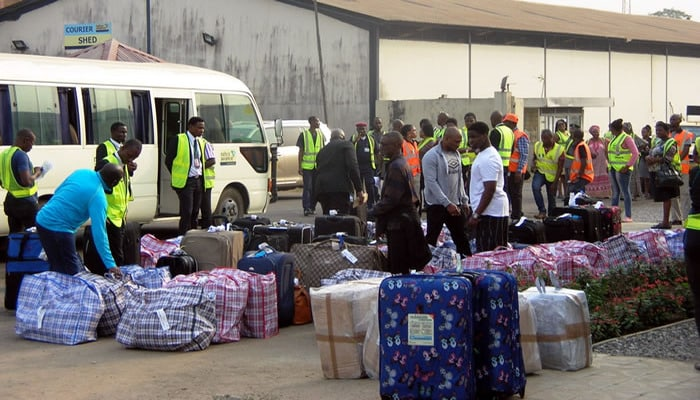
Authorities in Chad have picked up and deported hundreds of Nigerians who left their nation in search of safety. This action has sparked new worries about how refugees and migrants are treated in the Lake Chad region.
Approximately 600 Nigerians were detained in a series of coordinated operations last week and deported to neighboring Cameroon, according to some of the deportees who spoke with journalists.
Nearly 20 years after the Boko Haram insurgency started in 2009, security analysts have issued fresh warnings about a return of jihadist attacks in Nigeria’s northeast, according to Naija News.
“All Nigerians Are Boko Haram,” they said.
Nigerian Kyari Musa, who had been living in N’Djamena, the capital of Chad, described his experience, claiming that security personnel unexpectedly broke into his home.
“Security guards stormed our house on Friday.
They claimed that all Nigerian refugees ought to flee their nation because they are Boko Haram. They stole our biometric information, Musa told AFP.
He claims that the officials also gave deportees severe warnings.
He said, “They warned that whoever returns and is caught will spend 20 years in jail.”
The arrests were made in stages, according to Ari Modu, another Nigerian who said he barely evaded deportation after being bailed out.
“On Wednesday, the mass arrests began,” Modu revealed.
According to his estimation, 227 Nigerians were taken into custody on the first day, and 371 more were apprehended on Friday during follow-up raids.
According to Musa and Modu, the detainees were eventually taken to Kousseri, a border town in Cameroon that is directly across from N’Djamena, where they were abandoned. Some were then allegedly transported by Chadian customs authorities to the Nigerian border town of Gamboru.
Chad argues that this is a “routine operation.”
Although Chadian officials acknowledged that deportations occurred, they refused to disclose precise numbers, maintaining that Nigerians were not the focus of the operation.
The raid is a component of a larger immigration enforcement operation, according to Paul Manga, Deputy Director General of Chad’s National Police.
Manga told AFP, “The police conducted a roundup of people in an irregular situation, regardless of nationality, who were subsequently escorted to the border.”
“This isn’t a witch hunt.”
According to Naija News, Nigeria has been fighting a jihadist insurgency for 17 years, during which time militant organizations have split up and migrated to neighboring nations including Chad, Niger, and Cameroon.
Millions of Nigerians have been uprooted by the fighting and forced to seek safety abroad, especially in Chad, where some have lived and worked for more than ten years.
However, the presence of displaced people has continued to put pressure on regional security systems, making host nations more cautious about insurgency infiltration.
Although Nigeria has recently made it easier for its residents to voluntarily return home from neighboring countries, many returns encounter difficult circumstances upon arrival.
According to some deportees who were interviewed by journalists for earlier publications, they returned to unstable regions where they were still vulnerable to attacks. In Nigeria’s precarious economy, others who move to comparatively safer urban areas face unemployment and worsening poverty.