






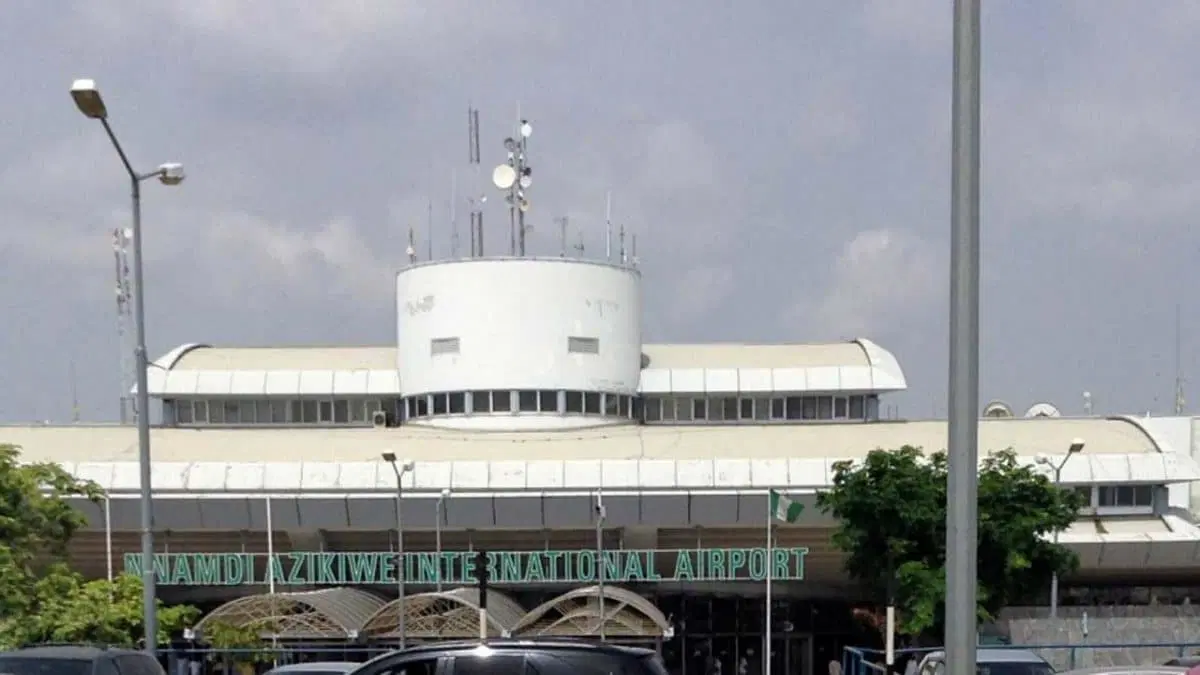

Due to significant traffic congestion brought on by the complete implementation of the Federal Airports Authority of Nigeria’s (FAAN) cashless policy at the Nnamdi Azikiwe International Airport in Abuja, both domestic and foreign travelers are abandoning their cars and walking inside the terminal.
According to Vanguard, many travelers are rushing to catch planned flights as a result of the “Operation Go Cashless” directive’s execution, which has resulted in lengthy lines of cars from the airport toll gate.
The disruption came as FAAN enforced its mandate requiring all airport revenue points—including entrance gates, parking lots, VIP lounges, and protocol services—to accept totally electronic payments.
Just six months ago, FAAN announced that all payments at its revenue points would be entirely electronic starting in September 2025. The organization described the initiative as a part of efforts to modernize airport operations, encourage transparency, and bring Nigeria’s aviation industry into compliance with international digital standards.
But until February, when FAAN revealed that the Federal Government had decided to completely implement the cashless policy starting on March 1, 2026, in order to prevent revenue leakages, enforcement remained essentially inactive.
The exercise is Abuja’s first full-scale execution of the instruction.
According to Vanguard’s findings, airport patrons must obtain a specific FAAN electronic payment card, which needs to be funded, registered, and scanned at entry points.
While some drivers tried using Point-of-Sale (POS) terminals or commercial bank ATM cards to make payments, many reported that the procedure is lengthy and frequently fails. There is severe traffic at the airport entry as a result of the delays.
In an attempt to avoid missing their flights, a number of stranded travelers have been observed hauling their bags on foot from the toll gate after leaving their cars.
Experts: Nigerians express worry about the new policies
Stakeholders in aviation contend that the crisis reveals more serious structural problems and that the federal government focused too much on revenue without taking operational realities into account.
Aviation analyst Olumide Ohunayo stated that while the airport cashless policy aims to increase transparency and efficiency, the rollout disregarded important factors like traffic management, commuter behavior, and local infrastructure constraints. He added that the authorities prioritized revenue enforcement over traffic engineering.
“The smooth flow of traffic should have been the foremost consideration while this policy was being developed. In this instance, revenue came before traffic flow, which is why there is a bottleneck, he explained.
In the meanwhile, social media reactions to the situation have persisted.
“Animal kingdom, the headquarters of anyhowness,” a user named @FadaChristmas_ wrote. Black folks are the only ones who know how to damage things. Because everyone is rushing to catch their flight and will lose a lot of money if they miss it, why are you planning a hold-up at an airport?
“The policy itself isn’t inherently bad—digital payments can improve efficiency,” said another user, @ChukwukaCj4. However, infrastructure, awareness, and execution must align with the plan. If not, you just replace one issue (slow traffic) with a more significant one (chaos and abandoned cars).
“There is nothing wrong with going cashless, but the implementation process needs both a human angle and enforcement,” @AdekunleOderind continued. Why not allow cash to flow on one side while testing the procedure during off-peak hours? We simply act randomly.
In a similar vein, @AwiHorace wrote, “This is what happens when policies aren’t well thought out.” People are harmed. POS cannot be used as a payment method at a toll gate. It must be a quick payment method, such as touchscreen payment. similar to what Lagos State has put in place at the city’s train stations. Although it will be expensive, doing it correctly is preferable to putting in place a barrier right away.
“Everything in this country is by fire by force,” stated @_noexcusez, another user. People shouldn’t have to suffer because one person believes the revenue officers are defrauding them; instead, this transition should be allowed to continue for at least a year.
As of the time of publication, security and traffic officials are having difficulty controlling the slow traffic entering the Abuja airport.