






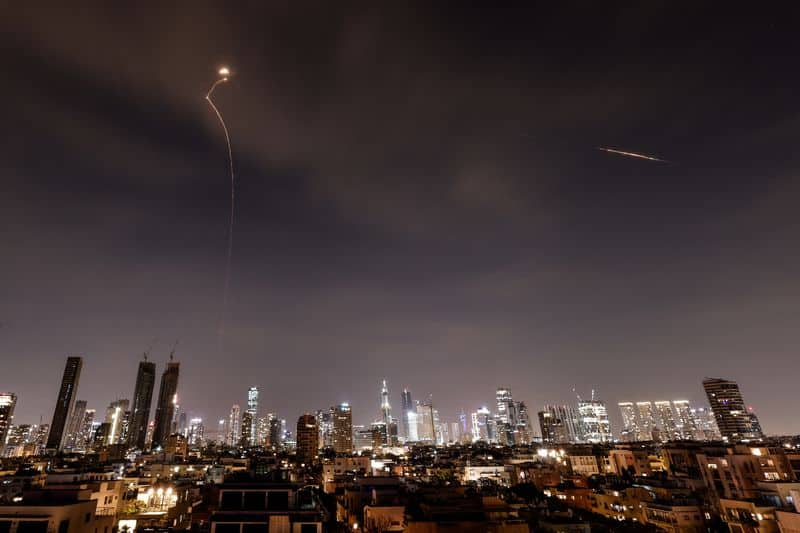
Despite indications from US President Donald Trump that Washington was looking for talks with Tehran, Iran blasted a fresh round of missiles across areas of the Middle East on Wednesday.
With oil prices declining and Asian stocks soaring in anticipation of a potential de-escalation after nearly four weeks of fighting, the new strikes coincided with evidence that the world’s markets were beginning to stabilize after weeks of stress.
Trump implied that diplomatic talks with Iran were in progress while addressing reporters at the Oval Office.
“We’re in negotiations right now,” the US president declared.
“Yesterday, they accomplished something very remarkable. The gift they gave us arrived today. Additionally, the gift was enormous and quite valuable.
“I took that to mean that we’re working with the right people.”
Trump said the discovery was connected to the Strait of Hormuz, a vital international oil shipping route that Iran has mostly blockaded in retribution for attacks by the United States and Israel, but he did not elaborate.
Formal conversations have not yet been confirmed by Iranian officials.
But according to The New York Times, Washington delivered Iran a 15-point proposal via Pakistan, which has offered to arbitrate the dispute.
It’s still unknown if Israel, which has been attacking Iran and the militant organization Hezbollah in Lebanon, is aware of or involved in the suggested diplomatic initiative.
Iran’s Revolutionary Guards claimed to have launched a fresh round of missiles against Israel and military installations housing US personnel in Kuwait, Jordan, and Bahrain in defiance of the diplomatic signals.
Iran has persisted in attacking Israel and Gulf nations it believes support US military activities in retaliation.
Drones Attack Gulf States Infrastructure
Drones hit a fuel tank at Kuwait International Airport, according to Kuwaiti authorities, resulting in a fire and what they described as minor damage.
While Jordanian authorities stated that shrapnel fell close to the capital, Amman, without causing any casualties, Bahrain’s interior minister verified that air raid sirens were activated.
Additionally, Saudi Arabia claimed to have intercepted at least four drones in the kingdom’s eastern region.
After the most recent missile launches, Israel declared that it would continue attacking what it called the “infrastructure of the Iranian terror regime.”
Iran, on the other hand, claimed that Israel had launched another attack on the civilian Bushehr nuclear complex.
People in Tehran said they were always under danger.
A 35-year-old lady told AFP over the phone, “The sounds, the explosions, the missiles, they are part of our daily life now.”
Fighting Extends to Lebanon
The fighting has also escalated in Lebanon, where six people were killed by Israeli attacks in a town and a camp for Palestinian refugees close to Sidon, according to official media.
Israel has stated that it plans to seize territory in southern Lebanon up to the Litani River, which is roughly 30 kilometers from the border, as part of its increased military effort against Hezbollah.
Approximately one-fifth of the world’s crude oil goes through the Strait of Hormuz, which continues to garner international interest.
The International Maritime Organization has received assurances from Iran that “non-hostile vessels” will be permitted to travel through the channel safely.
Tehran, meanwhile, issued a warning that ships associated with “the aggressor parties – namely the United States and the Israeli regime” would not be permitted to pass through the strait.
Benchmark crude fell by more than 6% as a result of indications of potential diplomatic breakthrough.
The price drop came after weeks of growing energy costs brought on by the conflict, which has also increased fuel prices in the US.
In the meantime, Iran was urged to take talks seriously by French President Emmanuel Macron.
After meeting with Iranian President Masoud Pezeshkian, Macron tweeted on 𝕏, “I called on Iran to engage in good faith in negotiations.”