






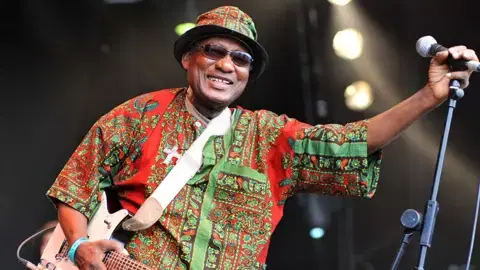
Since the passing of Ghanaian highlife icon Ebo Taylor, tributes have been coming in from all across Ghana and the world.
Taylor, who passed away on Saturday, was a guitarist, songwriter, and bandleader whose six-decade career significantly influenced contemporary popular music in West Africa.
Taylor, who is frequently referred to as one of the pioneers of modern highlife, passed away just one month after his 90th birthday and one day after the opening of a music festival in the capital, Accra, that bears his name.
A new addition to UNESCO’s list of Intangible Cultural Heritage is highlife, a form that combines jazz and Caribbean influences with traditional African rhythms.
“A giant has left the planet. A statement posted on his official Facebook read, “A colossus of African music.” “Your light will always shine.”
He was referred to be a pioneer of Afrobeat and highlife by the Los Angeles collective Jazz Is Dead, and his legacy was also honored by American producer Adrian Younge, who collaborated with Kendrick Lamar and Jay Z, and Ghanaian dancehall artist Stonebwoy.
He was called a “fantastic guitarist” and a “highlife maestro” by Nigerian poet and writer Dami Ajayi.
“Uncle Ebo”: Taylor’s impact went well beyond Ghana; his songs can be heard in the soul, jazz, hip-hop, and Afrobeat genres that currently rule the African and international charts.
He started playing in the 1950s, when highlife was becoming the most popular genre in Ghana in the years after independence. He was born Deroy Taylor in Cape Coast in 1936.
He performed with top bands like the Broadway Dance Band and the Stargazers and is renowned for his complex guitar lines and luscious horn arrangements.
He studied music in London in the early 1960s and collaborated with other African musicians, such as Fela Kuti, a pioneer of Afrobeat from Nigeria.
Later, it would be believed that the two’s intellectual interchange helped shape Afrobeat, a political concoction that combines jazz, soul, funk, and highlife.
While leading his own bands and working with celebrities like Pat Thomas and CK Mann, Taylor rose to prominence in Ghana as one of the most sought-after producers and arrangers in the nation.
As DJs, collectors, and record labels republished his music decades later, his compositions—such as “Love & Death,” “Heaven,” “Odofo Nyi Akyiri Biara,” and “Appia Kwa Bridge”—gained renewed international prominence. Hip-hop and R&B artists sampled his grooves, which allowed Ghanaian highlife reach new audiences around the world.
As part of a late-career comeback that solidified his reputation as a cult figure among younger musicians, Taylor continued touring into his 70s and 80s, playing all across Europe and the US.
Because of his longevity and ability to coach up-and-coming performers, many admirers referred to him as “Uncle Ebo.”
He continued to be seen by many as a representation of the golden age of highlife and of the generation that introduced Ghanaian music to the international scene.