






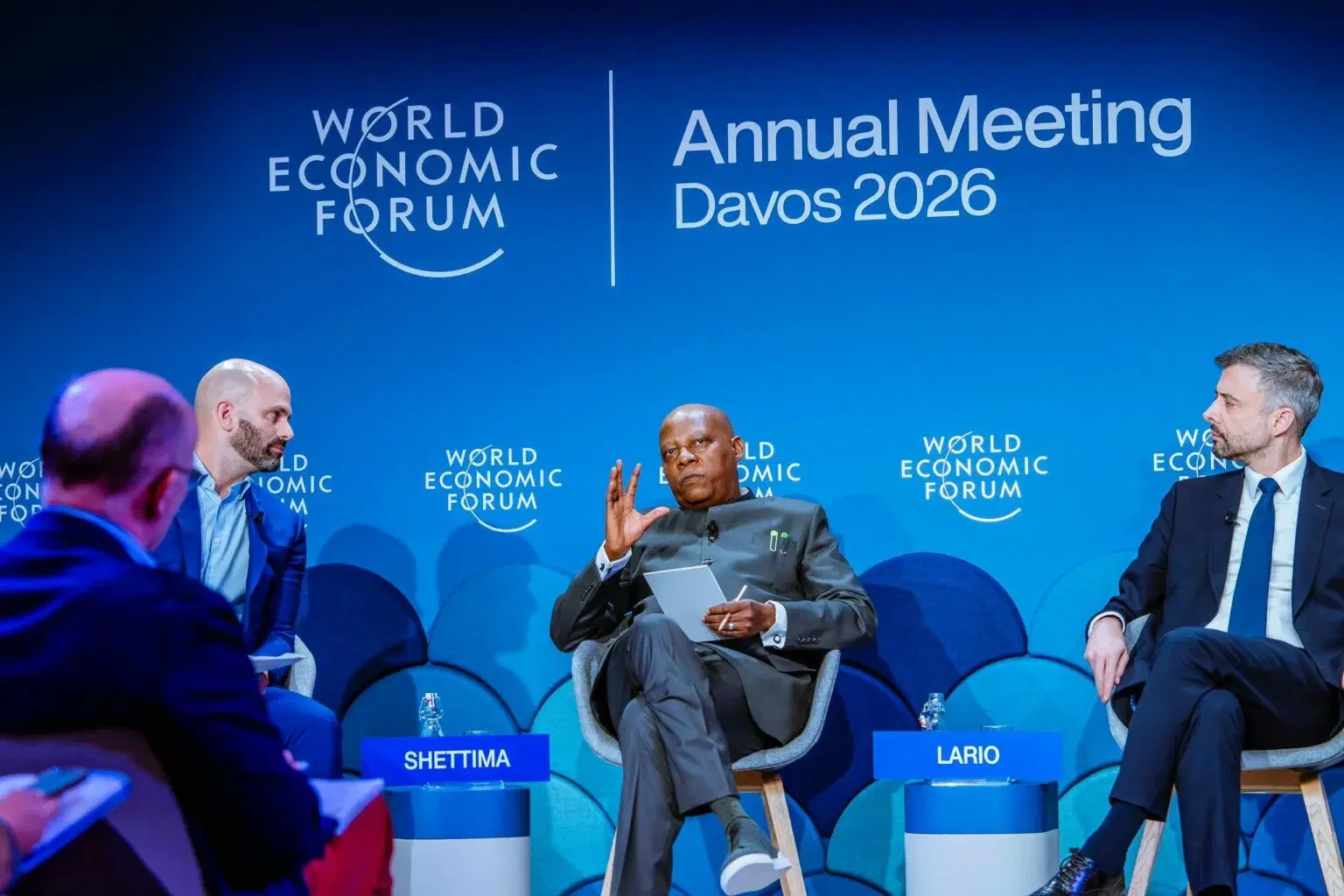

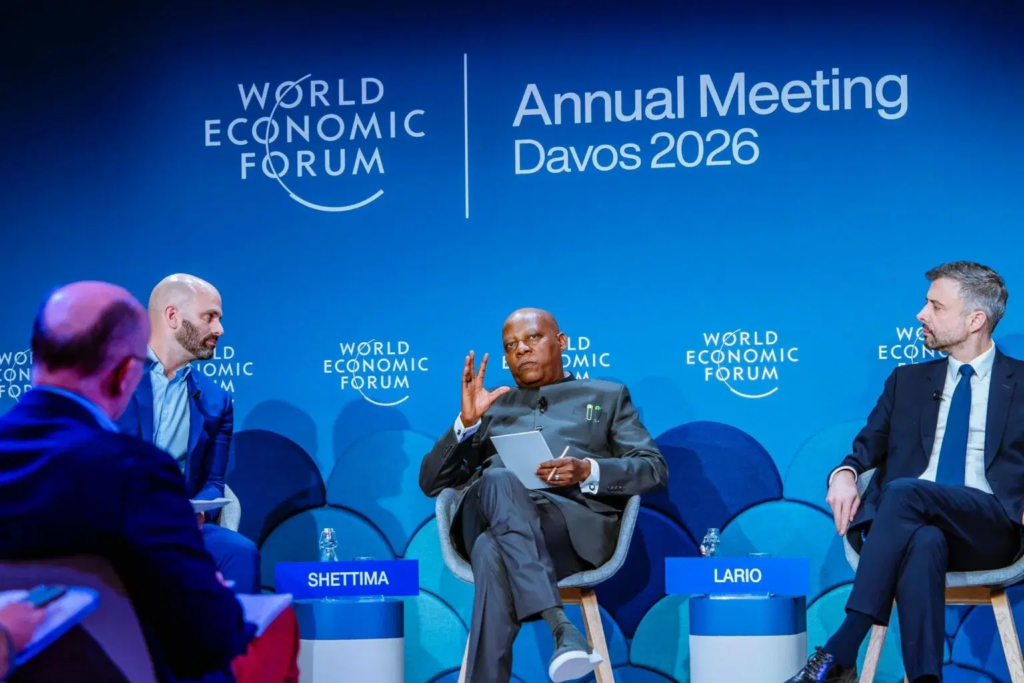
Kashim Shettima, the vice president, has promoted domestic fixes for Africa’s economic issues.
Shettima emphasized the necessity of creative strategies for the continent’s expansion, wealth, and progress.
On the fringes of the current 2026 World Economic Forum (WEF) Annual Meeting in Davos, Switzerland, he made this statement at a High-level Accra Reset Initiative meeting.
Shettima applauded the Accra Reset’s vision, characterizing it as a daring reinvention of Africa’s shared destiny based on sovereignty and self-definition and constructed through African-led cooperation.
“From dependency to dignity, from aid to investment, from rhetoric to results,” he added, the effort was a call to action and an attempt to change the way African countries think.
“It is a call to prosper together,” stated Shettima. And I have no doubt that if we respond to this appeal, the world will see an African boom based on creativity, industry, and interconnectedness rather than the sands of commodity cycles.
He said that African countries could only turn their natural abilities and population into true, resilient prosperity by increasing their domestic economic potential.
The vice president stated that wealth “must be homegrown and earned” rather than being expected to arrive overnight.
He noted that Africa was now the center of the world’s demographic and economic future rather than its peripheral.
Shettima emphasized that Africa can only advance when its nations develop, using Nigeria as an example, where the Dangote Refinery is progressively becoming the country a significant fuel exporter.
“Africa cannot rise on applause alone,” he continued. When we construct, we rise. Nigeria is about to become a net exporter of refined fuel after decades as a net importer of value, thanks to the Dangote Refinery, Africa’s largest refinery located in Lagos, Nigeria.
This is the result of combining industrial aspirations with African money. This suggests that when manufacturing is paired with infrastructure and clear policies, nations transition from being price takers to value makers.
“We decided to leapfrog rather than retreat even as manufacturing’s share of Africa’s GDP dropped from 16 percent in 1980 to less than 10 percent by 2016.”
The vice president emphasized the advantages of robots, artificial intelligence, and modular factories.
Africa may industrialize more quickly in the twenty-first century than it has in the past, he claimed, adding that the time when the continent is “known only for what it digs or grows” is now giving way to the time when it is recognized for what it builds.
He noted that “Africans abroad sent home about 95 billion dollars in 2024 alone,” which is roughly equivalent to all foreign direct investment and more than five percent of our GDP.
That isn’t charity. Because mobility is a competitive advantage in a world where human capital is the most valuable resource, we are also advocating for free movement throughout Africa.
“Prosperity will follow if skills and ideas are allowed to flow as freely as capital and goods,” he continued.
According to Shettima, the country has “seen the prosperity paradox up close,” and the experience has been shaped by the straightforward lesson that “prosperity is not imported; it is built.”
“There are markets and talent, but until demand is converted into domestic capability, resilience remains thin.”
This refers to businesses that manufacture, adhere to standards, and compete internationally. External wealth is brittle. Internal wealth is long-lasting.
“We have learned from Nigeria’s own market, which has more than 200 million people, that latent demand is meaningless unless we develop local supply.”
We can only create genuine, resilient prosperity from our population and natural resources by increasing domestic productive capability. According to Shettima, prosperity must be gained and nurtured.
Ghanaian President John Mahama clarified that the Accra Reset Initiative, which was introduced at the most recent UN General Assembly in New York, was neither a wish list nor a proclamation.
“But a practical answer to a question millions of young Africans are asking about the continent’s future and response in changing global order,” he stated.
Although “no specific name has been coined for the new global system that will emerge,” the president urged African leaders to work together.
“Africa intends to be at the table in determining what that new global order will look like,” he continued.
Olusegun Obasanjo, the former president, focused on what Africa needed in the “new age of disruption, uncertainty, and unpredictability” in order to claim its proper place in the international community.
The former president said, “The Accra Reset Initiative has come to inspire leaders to stop complaining about the system that has changed or is changing and to build a way through it.”
Prof. Yemi Osinbajo, a former vice president, stated that the forum’s main goal was to mobilize support for African countries to reconsider their approaches to economic transformation and solve issues facing the populace. (NAN)