






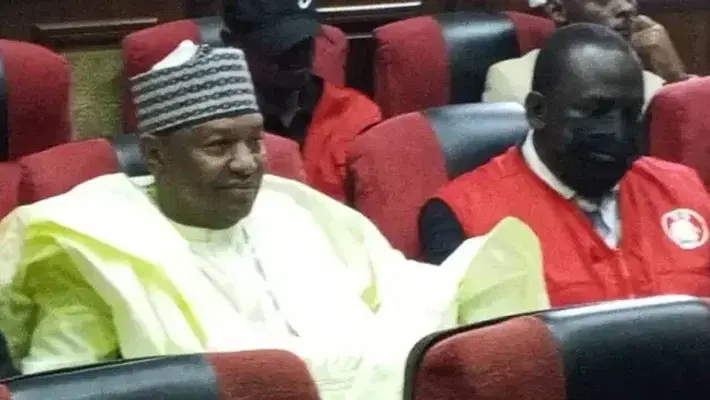

The Economic and Financial Crimes Commission (EFCC) accused Mr. Abubakar Malami, SAN, the former Attorney-General of the Federation and Minister of Justice, of money laundering. On Thursday, Justice Obiora Egwuatu, a judge of the Federal High Court in Abuja, recused himself from the case.
A second case involving 57 choice properties that the anti-graft agency said were connected to the former AGF and that the court had previously ordered temporarily forfeited to the Federal Government was also dropped by the trial judge.
The Chief Judge recently handed both cases to Justice Egwuatu, who claimed that he was unable to proceed with them for “personal reasons.”
He insisted that the case files will be sent back to the CJ to be transferred to a different judge for decision-making in the interest of justice.
Malami is charged with 16 counts of money laundering. Malami was the Justice Minister under former President Muhammadu Buhari from November 11, 2015, until May 29, 2023.
Along with his son Abdulaziz and one of his wives, Hajia Bashir Asabe, he was arraigned in court.
It was alleged that the accused had laundered around N9 billion in state funds.
The EFCC claims that the defendant bought upscale residences in several states and towns, such as Abuja, Kebbi, and Kano, in an effort to conceal the money he had earned from his criminal activities.
On January 6, Justice Emeka Nwite, who was serving as a vacation judge, ordered the temporary confiscation of the 57 properties that were purportedly linked to the former AGF in response to an ex parte motion that the agency had filed with the court.
The EFCC was instructed by Justice Nwite to publish a notice calling anyone having a stake in any of the properties to come to court and provide justification for why they shouldn’t be given up to the government.
Nevertheless, the case files were moved to Justice Egwuatu for the continuation of the proceedings when the holiday time ended.
Justice Egwuatu, meantime, declared his intention to drop both cases shortly after the first one involving the 57 properties was called up on Thursday.
The EFCC said the court that Malami and his co-defendants had concealed more than N1.01 billion in a Sterling Bank account between July 2022 and June 2025 by using a company called Metropolitan Auto Tech Limited.
They were also charged with embezzling around N600 million between September 2020 and February 2021 using the same firm.
Similarly, the EFCC informed the court that, in March 2021, the defendants kept N600 million as cash collateral for a N500 million loan that Rayhaan Hotels Ltd. received from Sterling Bank, even though they were reportedly aware that the money was the proceeds of criminal activity.
The defendants were accused of violating many clauses of the 2011 Money Laundering (Prohibition) Act.
Investigators, bank officials, real estate brokers, and Bureau de Change operators were among those summoned to testify against them.
Although Malami filed a motion to have three of the 57 seized properties released to him, along with an explanation of his wealth, the defendants have since refuted the accusations.
He informed the judge that while he received one of the assets from his deceased father, the others were purchased prior to his appointment as AGF.
The three properties were identified by Malami as follows: a bedroom duplex and boys quarters at No.12, Yalinga Street, Off Adetokunbo Ademola Crescent, Wuse Il, Abuja, which was purchased in October 2018 for N150 million; the ADC Kadi Malami Foundation Building, which was purchased for N56 million; and Plot 157, Lamido Crescent, Nasarawa, GRA, Kano, which was purchased on July 31, 2019.
In particular, the troubled former AGF requested two requests in the filing he made through his legal team, which was headed by Mr. Joseph Daudu, SAN:
The properties listed as Nos. 9, 18, and 48 in the schedule of properties attached to the interim order of forfeiture of January 6, 2026, belong to the respondent/applicant (Malami) and have been duly declared in the respondent/applicant’s asset declaration forms throughout his tenure as a public officer. No. 48 is held in trust for the Estate of Late Khadi Malami Nassarawa. “An order of this honorable court vacating, setting aside, and/or discharging the interim order(s) of this honorable court made on January 6, 2026 against the respondent/applicant.
Additionally, in the course of allegedly carrying out the court’s order dated January 6, 2026, “an order of this honorable court restraining the applicant/respondent (EFCC), acting alone or through its servants, agents, and proxies, from interfering with the respondent/applicant’s (Malami’s) properties in issue or disturbing the respondent/applicant’s ownership, possession, and control of them.”
He insisted that the EFCC had not presented any preliminary evidence to prove that the property was obtained through the proceeds of crime, telling the court that it was properly listed in the numerous asset declaration forms he filled out and filed with the Code of Conduct Bureau (CCB).
Malami stated that he held the property with the address No. 48 in trust for the benefit of his late father, Late Kadi Malami, who passed away.
“The numerous asset declaration forms from 2019 to 2023 have explicitly described and shown these assets, their value, and their root of title.
“The aforementioned declaration serves as initial proof of the validity of the purchase and possession of the properties,” he continued.
The former AGF listed his sources of income, telling the court that he had earlier told the CCB that he earned N374, 630,900 million from severance pay, estacodes, and wages, among other sources;
“Sitting allowances as a member of the Federal Judicial Service Commission, Federal Capital Territory Judicial Service Commission, Legal Practitioner Privileges body, and a powerful presidential body.
As revenue from sold assets, N574, 073, 000 (five hundred seventy-four million and seventy-three thousand naira) was earned.
The total turnover from enterprises is N10, 017,382,684 (ten billion, seventeen million, three hundred and eighty-two thousand, six hundred and eighty-four thousand naira).
“Business loans of N2, 522,000,000 (two billion, five hundred and twenty-two million naira)
“A customary gift from close friends, N958,000,000 (Nine hundred and fifty-eight million naira).”
He informed the court that the launch and public presentation of his book, “Contemporary Issues on Nigerian Law and Practice, Thorny Terrains in Traversing the Nigerian Justice Sector: My Travails and Triumphs,” generated a total revenue of N509,880,000 (five hundred and nine million, eight hundred and eighty thousand naira).
“These sources of income, along with the ongoing profits from the businesses over the years, adequately demonstrate that the properties sought to be forfeited were obtained through legal and legitimate means as stated in the asset declaration forms,” he said.
Malami claimed that the court had moved against him over property that “were lawfully acquired post appointment of the respondent/applicant and declared with the Code of Conduct Bureau as legitimate assets of the respondent/applicant, in compliance with the 5th Schedule to the Constitution of the Federal Republic of Nigeria, in 2019 and 2023.” Malami accused the EFCC of obtaining a forfeiture order against him by suppressing material facts.
He contended that the court’s discretion in issuing an order based on fabricated facts and conclusions by the applicant/respondent (EFCC) was adversely affected by “manifest exaggeration, malicious inflation of the value of the assets, and unreasonable and incompetent valuation purposefully manipulated to mislead.”
that the applicant’s basic rights to property, his assumption of innocence, and his right to live in harmony with his family are being violated by this procedure,” Malami continued.