







By KUNLE SANNI
Benue State has proudly held the title of “Food Basket of the Nation” for many years. Millions of Nigerians have been supported by its large arable land and robust farming culture. However, agriculture has not been enough to protect the state and the country as a whole from revenue volatility, youth unemployment, or economic shocks.
Acknowledging this fact, Rev. Fr. Hyacinth Iormem Alia’s government has started a purposeful and significant change, shifting Benue’s economy to a more expansive industrial and fiscal base while maintaining its essential agricultural strength.
Governor Alia’s government has faced significant socioeconomic challenges since taking office on May 29, 2023. For example, according to data from the state budget commission, the North-Central state had over 28,997 conflict-related deaths as of 2022, indicating a protracted period of increased insecurity, while the state’s official unemployment rate was approximately 12%.
In order to stabilize the state’s economy and increase its productive base, Governor Alia’s government has implemented a program of structural changes in response to these circumstances.
The establishment of the Food Basket Brewery, FBB; BenFruits, a bakery; the state-owned printing industry; and a clothing factory, which primarily use its local raw agricultural supplies and develop into a hub for agro-processing and manufacturing, is at the heart of this program.
The Factory of Breweries
The Benue Investment and Property Company Limited, or BIPC, is the state-owned industrial project that established the FBB in 2025. The N15 billion brewery, which makes beers and other drinks including Zeva and Oyi Bitters, is situated in Makurdi, the capital of Benue State, on roughly 1.2 hectares along the Makurdi–Gboko Road.
The brewery is expected to create up to 1,500 direct and indirect jobs when it opens fully in November of last year, greatly boosting employment and industrial growth in the state. About 40 local Benue youths are employed and trained by the Chinese machine manufacturers who oversee and maintain the production equipment.
The capacity of the brewery is organized according to shifts. The brewery, for example, makes 1,000 bottles every hour. In an eight-hour shift, for instance, the FBB can reach 8,000 bottles. According to an analysis by state officials, production can quadruple to 16,000 bottles in a day with day and night shifts.
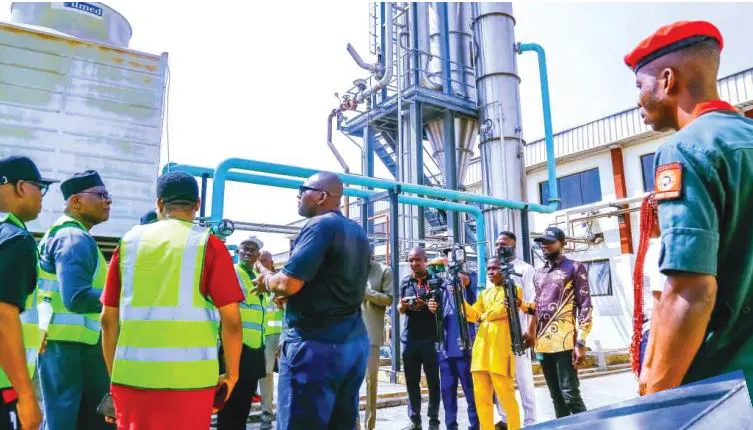
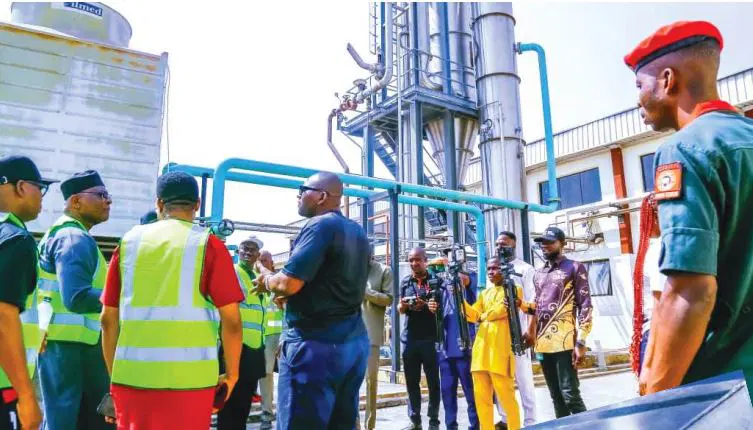
Henry Boager, a maintenance officer with BIPC, told top Nigerian editors from the Nigerian Guild of Editors, NGE, led by Bayo Onanuga, President Bola Tinubu’s Special Advisor on Information and Strategy, during a project inspection tour last week that the Benue State government plans to raise the salary and welfare package for Nigeria Brewery employees, bringing it into compliance with an improved standard and structure.
“We plan to make improvements to our structure so that our brewery employees will be more comfortable.
For example, the Benue State government will offer a two-shift work schedule, including morning and evening shifts, as well as transportation options, such as a bus that drives employees to work. Additionally, they continue to feed the employees lunch, he continued.
Speaking about the factory’s raw material sourcing, the BIPC official disclosed that although the state government imports raw materials like sorghum and malt for beer production, the governor has since urged state farmers to grow those materials to ensure sustainability.
“The raw materials actually grow within certain temperatures that are not favorable in Benue,” he stated. Additionally, we are developing a method to create and store them at a temperature that is appropriate for their manufacturing.
166 chiller refrigerators were reportedly sent to the BIPC for distribution to Zeva premium beer dealers, Oyi Bitters.
Dr. Raymond Asemakaha, the group managing director of BIPC, who accepted the shipment, stated that it was a significant step forward in the company’s endeavors to close supply gaps in its manufacturing chain.
The Benfruit Plant
In contrast to the beer factory, which temporarily receives its raw materials from outside the state, the juice plant purchases its ingredients—such as mango, oranges, and pineapple—directly from nearby Benue farmers in order to make its assortment of juice products.
On February 28, the facility, which is currently installing high-capacity machinery on a large scale, is anticipated to start full operations. With a capacity of four metric tonnes per hour, it is intended to process local oranges and mangoes. During a tour to the factory in the Markudi Industrial Layout, Boager stated, “We know that raw material is never a problem because we have it here locally.”
Boager clarified that the state’s orange processing facility can handle eight tons of oranges per hour, producing 60,000 liters of juice—enough to fill roughly 80,000 cartons in an eight-hour day—when asked how many tons of oranges the state government would be purchasing directly from nearby Benue farmers.
“I know, for example, we have an eight tons per hour processing unit for oranges,” he remarked. Therefore, it takes 32 tons if we can move eight tons per hour and one trailer. You can see how many trailers we can complete in a day by dividing 32 tons by eight. Thus, that is a simple computation.
Nigeria’s top orange grower, Benue State, accounts for a sizeable portion of the nation’s yearly orange production of around 930,000 tons; the state’s total citrus production is believed to be over one million metric tonnes.
Boager disclosed that the oil recovered from the fruit is mostly intended for export, even though the factory generates juice and wants to extract oil and make organic fertilizer from trash.
Although fruit concentrate is produced in the nation, he continued, only big beverage firms like Chifoods and Coca-Cola can afford to buy it and use it to make their own drinks using proprietary formulations.
State-Owned Printing Press, Fashion, and ICT Center in Benue
After decades of dormancy, Governor Alia’s government has effectively revitalized the Benue State Printing and Publishing Corporation, which was first founded on March 3, 1977. The company, which is based in Makurdi, is currently a fully operational state-owned business.
Under the direction of Mr. Joel Terhemen Mtsor, Managing Director, the company offers both public and private customers premium commercial, digital, and offset printing services. The company now employs more people and provides graphic design and bookbinding services. Notably, the company employs about 50 regular and temporary workers and has a capacity of more than 22 powerful industrial printing machines.
The state’s ability to print private documents, notably Certificates of Occupancy (CofO) for local government land usage and examination papers, which were formerly transported to neighboring states like Plateau, has improved since its revitalization.
“We run from Monday to Sunday,” Mtsor stated. Additionally, our employees work shifts to support their productive job. One of the machines we have is a Deep Buzz machine. The banner machines are those. A printing machine can’t do everything. The machinery used to make banners are not the same as those used to make T-shirts. These machines are not the same ones used for high-volume paper printing brushing.
No, paperwork is handled by more than just the printing press. Here, we are producing T-shirts. Here, we make face caps. We create brochures and banners. We also produce calendars in large quantities.
“Aside from the one in Benue, there is no state-owned printing company in North-Central, and no private printing press in Benue has this kind of capacity,” he continued.
The ultra-modern Benue Fashion and ICT Hub in Makurdi was commissioned on August 27, 2024, as part of the state government’s efforts to bolster its drive for industrial growth and employment creation.
Senator Ibrahim Hassan officially opened the facility on Vice President Kashim Shettima’s behalf.
Hadejia, the President’s Deputy Chief of Staff.
The state-owned facility has more than 200 cutting-edge fashion machines for manufacturing corporate, military, and school uniforms in addition to an ICT department with more than 100 devices for teaching young people digital skills. The project is anticipated to provide roughly 48,000 employment each year.