



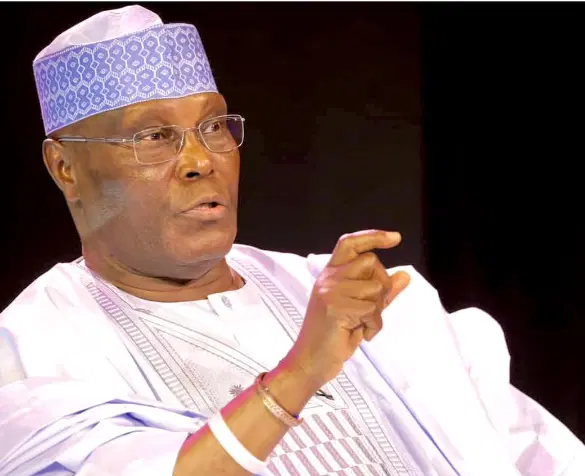
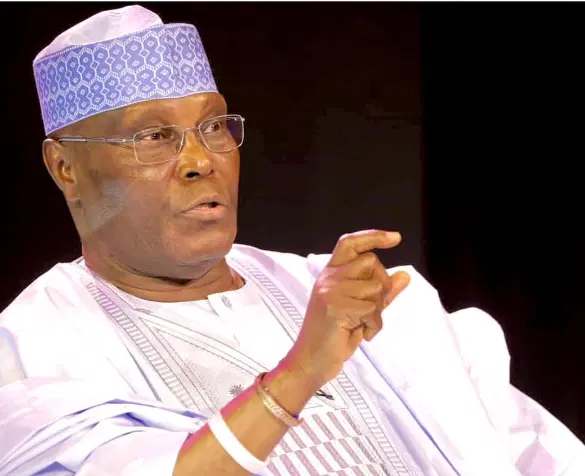
According to former Vice President Atiku Abubakar, the Nigerian National Petroleum Company Limited’s acknowledgement that the $1.5 billion Port Harcourt Refinery refurbishment was a waste of limited resources supports his long-standing demand that Nigeria’s state-owned refineries be privatized.
In response to remarks ascribed to the state oil firm that the Port Harcourt facility is not profitable even after $1.5 billion was spent on rehabilitation, Atiku made the claim in a message posted on his X handle yesterday.
Speaking on Wednesday, NNPCL Group Chief Executive Officer Bayo Ojulari revealed that the nation was suffering a “monumental loss” from the state-owned refineries, which prompted his leadership team to suspend operations in order to stop further value erosion.
Nigerians were upset on the refineries. Expectations were very high, and a lot of money has been invested. Accordingly, we were under tremendous pressure, Ojulari stated.
“The first thing that became evident—and I want to state this clearly—was that we were losing against Nigeria by a huge margin. All we were doing was squandering cash. I can now say that with assurance.
“We were investing a lot of money in contractors and operations. However, if you look at the net, we were simply wasting money,” he stated.
Atiku responded by saying that the admission, despite its lateness, proves that it is not economically justified for the government to continue financing idle refineries.
The Nigerian National Petroleum Company Limited has finally acknowledged that reopening the Port Harcourt Refinery is a waste of limited resources after squandering $1.5 billion.
He declared, “This late admission confirms my long-held belief that Nigeria’s refineries ought to be privatized.”
The former vice president continued, “It is instructive that the Tinubu administration has finally accepted an inevitable truth: investing public funds in refineries that are in decline is economically unjustifiable.”
He said that such spending is not in the best interests of the country and criticized what he called the payment of billions of naira in salary to oil-free institutions.
Atiku recalled that he had previously been assaulted and charged of trying to sell state assets to allies, despite his unwavering support for the privatization of the refineries.
I promoted this patriotic stance for years, during which time I was demonized and charged of conspiring to sell public assets to “friends.” The rhetoric has been overtaken by the realities today,” he remarked.
He claimed that decades of ineffective turnaround maintenance had cost billions of dollars and shown gaps in financial discipline, technical know-how, and capability.
He also maintained that political pressure, not economic reasoning, was the driving force for the most recent attempt to resurrect the refineries, emphasizing that good policy should never be replaced by politics.
Any planned refinery arrangement, even those involving foreign partners, should be abandoned, according to Atiku, since they only reproduce strategies that have already failed.
He continued by saying that Nigeria would have been better off selling the refineries before they were rehabilitated in order to prevent mounting debt and the gradual depreciation of assets that had essentially turned into liabilities.