



Israel began further attacks on Iran and Lebanon on Wednesday, according to official media, while Iran’s Guards claimed to have blocked one of the most important oil shipping lines in the world.
On the fifth day of a conflict that sent equities plummeting, Iran increased its retaliatory missile and drone onslaught while governments rushed to evacuate nationals trapped in the Middle East.
Iran’s Revolutionary Guards claimed to have “complete control” of the Strait of Hormuz, the vital chokepoint into the Gulf, despite the fact that the war is already driving up global energy costs.
However, Trump said that the US Navy was prepared to accompany tankers through the channel that one-fifth of the world’s seaborne oil passes through, and that the US had “knocked out” Iran’s navy, air force, and radar systems.
Since commencing deadly strikes with Israel on Iran on Saturday that resulted in the death of Iranian leader Ayatollah Ali Khamenei, the US military claimed to have attacked about 2,000 targets.
Israel continued its onslaught, with its military declaring a “broad wave of strikes” over Iran around midnight. Iran had fired three waves of missile barrages toward Israel in the preceding hours.
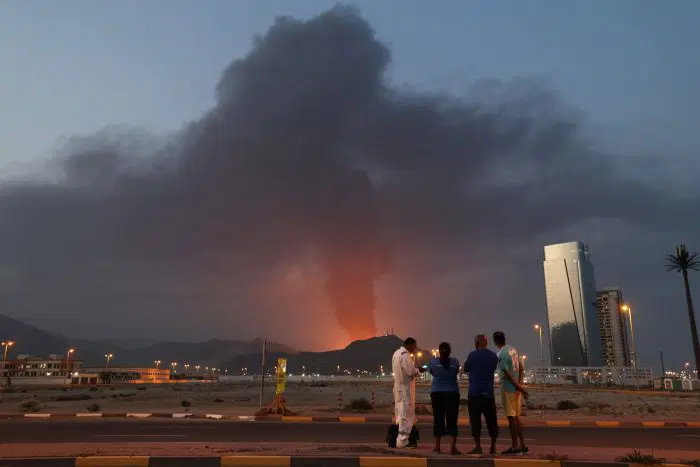
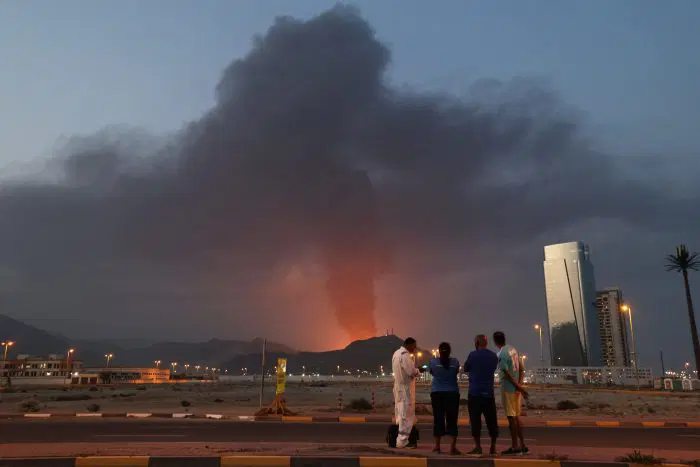
Drones attacked the US military facility at Al-Udeid in Qatar and the US embassy in Dubai, igniting a fire, while Saudi Arabia claimed to have intercepted two cruise missiles.
Even though air travel has been severely interrupted, the United States advised all Americans to leave the region if they could locate commercial planes, while governments like Britain and France sent in chartered flights to get their residents out.
Hezbollah, a militant organization sponsored by Iran, has launched missiles and drones toward Israel in retribution for the death of Iran’s supreme leader, Ali Khamenei, in the initial US-Israeli strikes. This is an urgent warning.
Before employing force against Hezbollah members, the Israeli military issued a “urgent warning” early on Wednesday, urging citizens to flee 16 towns and villages in southern Lebanon.
Israeli attacks on a building in Baalbek, in Lebanon’s east, far from the border, and a hotel in Beirut, in an area that has not yet seen unrest, killed four people, according to Lebanese official media.
Six people were killed and eight injured by Israeli strikes in Aramoun and Saadiyat, two communities south of Beirut and outside of Hezbollah’s usual strongholds, according to the health ministry. This was a “preliminary toll,” it warned.
The Israeli military, which had earlier declared “broad-scale strikes” on Hezbollah, did not immediately react, and it was unclear what was targeted in these cities or in Baalbek.
Trump claims that more leaders have been killed.
According to US Central Command chief Admiral Brad Cooper, the US military has been attacking Iran since Saturday, focusing on ballistic missiles and “all the things that can shoot at us.”
“These forces bring a massive amount of firepower, representing the largest buildup by the US in the Middle East in a generation,” he stated in a video message, comparing the initial day’s assault to the 2003 “shock and awe” against Saddam Hussein’s Iraq.
Trump retracted a remark made the day before by Secretary of State Marco Rubio, who claimed that Israel’s plans to strike were the reason behind the timing of the US attack.
At the White House meeting with German Chancellor Friedrich Merz, Trump remarked, “If anything, I might have forced Israel’s hand.”
Both Trump and Israeli Prime Minister Benjamin Netanyahu have called on Iranians to rebel, although Trump stated that the objective was not regime change.
The attack occurred weeks after thousands of people were killed as Iranian authorities suppressed large-scale protests.
Western countries have limited their assistance for the United States and Israel to aiding Gulf states and repatriating individuals.
The US president claimed that Iranian leaders he had considered as possible new leaders had been slain by two rounds of US-Israeli attacks and that a gathering to select the new leadership had been the target of a “substantial” new attack.
He remarked, “Most of the people we had in mind are dead.” We now have a second group. According to sources, they might also be dead.
The Iranian Red Crescent reports that 787 people have died in Iran as a result of US and Israeli attacks; AFP was unable to independently verify this number.
Iran has often threatened to exact a high price in retribution.
General Ebrahim Jabbari of the Islamic Revolutionary Guard stated, “We are telling the enemy that if it decides to hit our main centers, we will hit all economic centers in the region.”
Ghost Town
Fearing the US-Israeli assault, inhabitants of Tehran who have not fled have stayed inside their homes.
In recent days, “there are so few people that you’d think no one ever lived here,” according to Samireh, a 33-year-old nurse. Normally, the Iranian capital is home to some 10 million people.
Police officers, armed security personnel, and armored vehicles have been stationed at major intersections to conduct sporadic vehicle inspections after authorities had previously advised citizens to avoid the city.
The normal cacophony of traffic jams was replaced by the meowing of cats and chirping of birds in Tehran’s more affluent north.
Over 150 people were murdered in an attack on a school in the city of Minab on the first day of the war, according to Rwandan authorities. AFP has not been able to independently visit the site to confirm the circumstances or toll.
The first of six soldiers slain was named by the US military. On Sunday, a rocket struck the Israeli town of Beit Shemesh, killing nine people.
Over the Gulf, at least eight individuals have perished.
The government of Lebanon claims that at least 52 people have died as a result of Israeli strikes, while the UN reports that over 30,000 people have been displaced.
According to Tedros Ghebreyesus, the head of the World Health Organization, three paramedics were killed in Lebanon.