



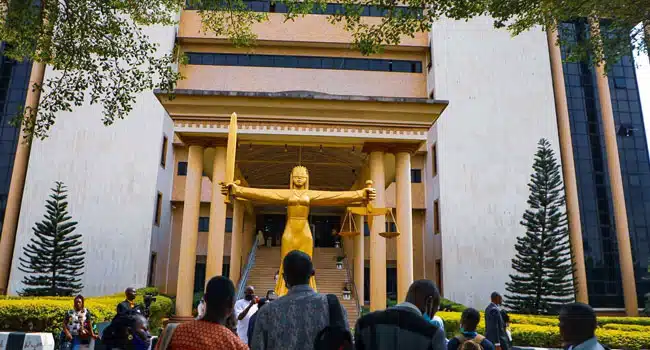
Joel Adoga, one of the defendants on trial with former Kaduna State Governor Nasir El-Rufai for suspected fraud, filed a fundamental rights enforcement lawsuit, which the Federal Capital Territory High Court in Jabi, Abuja, dismissed.
The Independent Corrupt Practices and Other Related Offences Commission (ICPC) did not breach Adoga’s constitutional rights throughout its inquiry, according to Justice M.S. Idris, who gave the ruling. The anti-graft agency proceeded in accordance with the law.
According to Naija News, Adoga had petitioned the court, claiming that the ICPC had illegally violated his fundamental rights.
He said that during his investigation, the Commission prevented him from communicating with his family and attorneys. Additionally, he asserted that he was forced to make comments against his will by investigators.
Adoga requested that the court rule that his rights had been infringed based on the accusations.
In addition, he requested monetary damages, a habeas corpus order, and injunctions prohibiting the ICPC from looking into, detaining, or prosecuting him further.
ICPC Disavows Claims
In response, the ICPC rejected all of the accusations, maintaining that Adoga had not been wrongfully detained or subjected to pressure, intimidation, or cruel treatment.
Adoga was invited for interrogation, the Commission informed the court, in response to a petition and reasonable suspicion that connected him to alleged corrupt activities and dubious financial transactions involving the purported misappropriation of Kaduna State Government funds.
Adoga was granted administrative bail during the inquiry, according to the ICPC, and was only placed under custody following the issuance of a legitimate remand order by a competent court.
The anti-corruption organization went on to say that Adoga was charged before the Federal High Court in Kaduna following the conclusion of its investigation, where he was arraigned and given bail.
It further stated that Adoga’s failure to comply with the trial court’s bail requirements was the reason for any ongoing imprisonment, not the Commission’s responsibility.
Adoga was never denied access to his family or attorneys, according to the ICPC, and all of the statements he made during the investigation were voluntary, cautiously recorded, and made in front of his attorney.
No Proof of Rights Abuse Is Found by the Court
According to Justice Idris’ ruling, the applicant was unable to prove that his constitutional rights were breached by the ICPC.
The judge dismissed the whole lawsuit after finding no merit in the accusations made against the Commission.
The court also confirmed that the ICPC’s conduct during the probe were compliant with the law.
According to Naija News, Adoga and former Kaduna State Governor Nasir El-Rufai are presently facing a 10-count charge at the Federal High Court in Kaduna.
El-Rufai allegedly received different amounts of money in US dollars through his Guaranty Trust Bank domiciliary account between 2016 and 2023, according to the accusations.
Adoga allegedly gave the former governor $320,800 in installments, according to the prosecution. Investigators believe that other transactions into the account, including $155,800, $305,300, and a number of lesser amounts from various people, are the result of illegal activity.
Adoga was also charged by the prosecution with conspiring with El-Rufai in July 2019 to hide the source of a $10,000 deposit made into the account.
The ICPC reaffirmed its dedication to maintaining the rule of law and honoring each Nigerian’s constitutional rights after the ruling.
The Commission declared that it would continue to investigate and prosecute corruption and associated offenses as required by law, making sure that due process is followed at every turn.