



By Ishola Balogun
The Muslim Community of Lagos State (MCLS) has vowed not to back any political party that nominates a non-Muslim for governor in the upcoming general election, expressing grave concern over what it called the marginalization of Muslims in state administration and political appointments.
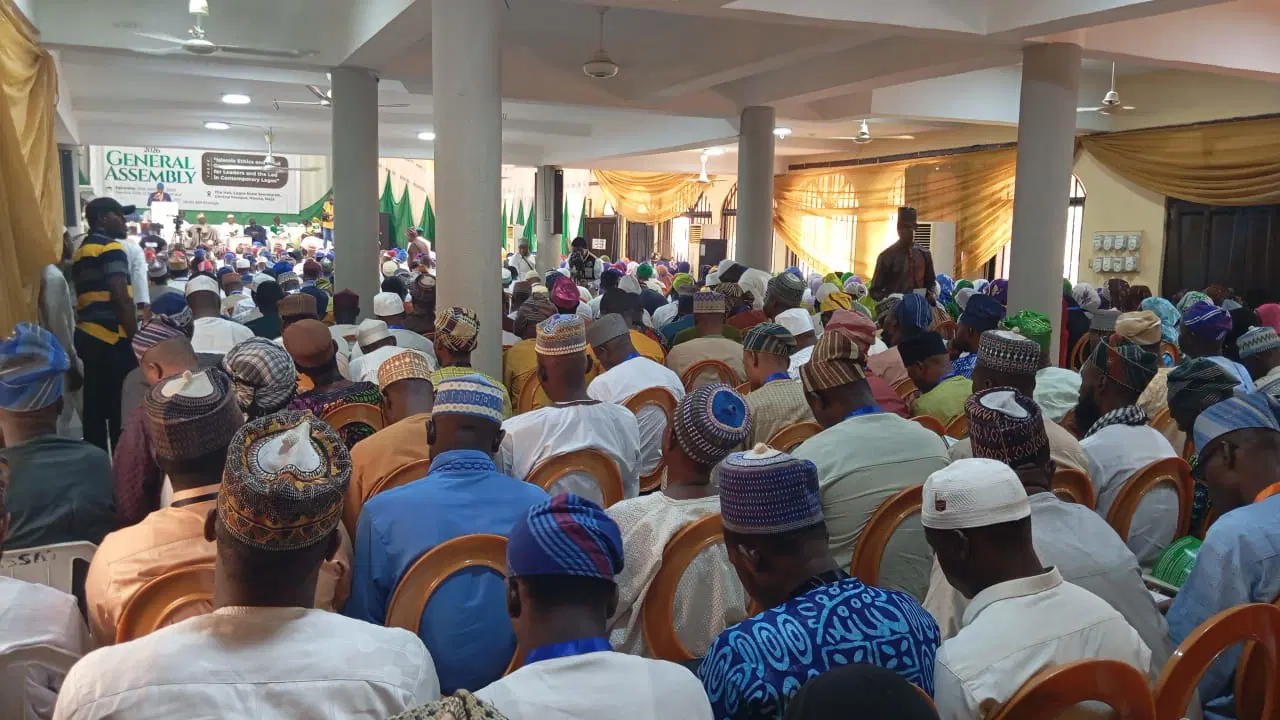
The group bemoaned the marginalization of Muslims in important fields, especially education, and demanded the hiring of Arabic and Islamic Studies instructors for public schools during its first General Assembly, which took place last Saturday at the Lagos State Secretariat Mosque Hall in Alausa, Ikeja.
In a strongly worded resolution, the Assembly announced that Muslims will not support any political party that offers a non-Muslim candidate in the 2027 governorship race. “We cannot continue to be sidelined in our own state. According to the statement, “the Muslim community will only support a candidate who represents our values and interests.”
Over 1,000 Muslims from various divisions and local governments throughout Lagos attended the event, which was characterized by heated discussions, motions, and unanimous resolutions. Members supported the interim financial report for 2024 and 2025 pending audit, ratified trustee nominations, and endorsed the new constitution of the community, which introduces the Islamic system of Shurah for choosing offices.
The event’s speakers emphasized the importance of Muslims coming together and being involved in politics. The Lagos State Government was requested by the Assembly to hire Arabic and Islamic Studies teachers for public schools and to guarantee religious parity in the selection of tutors general and permanent secretaries in each of the six educational districts. Additionally, it urged the government to follow the Supreme Court’s decision regarding female Muslim students’ usage of the hijab and to address what it called the marginalization of Muslims in positions of political and medical authority.
In his keynote speech on behalf of Dr. Obafemi Hamzat, the Deputy Governor of Lagos State, Alhaji Tajudeen Afolabi emphasized the issue of low followership, pointing out that citizens’ greed, immorality, and apathy have all led to poor governance. “If we are to achieve meaningful change, the followers must rise above laid-back attitudes and unwholesome acts,” he stated.
Prof. Saheed Timehin of Lagos State University (LASU) underlined the necessity of value reform, collective responsibility, and active engagement in governance. Prof. Nasir Onibon urged residents to embrace self-evaluation and sincerity of purpose, adding that strong leadership is a reflection of good followership. “Once the followers are good, the leaders will get it right,” he noted. Professor AbdulKabir Paramole, who is also from LASU, warned against the culture of inflating costs and distorting facts while illuminating how dishonesty and corruption among followers harm growth. He insisted that followers must contribute to the development of the country and warned against cursing leaders for measures that are seen as harsh.
The Assembly ratified the nomination of trustees, including Tajudeen Oluyole Olusi, Prof. Tajudeen Gbadamosi, Chief Bode Oyedele, Imam Yahyah Ishola, Dr. Abdulkareem Seriki, Alhaja Muhibat Wonu Folami, Ramlat Muri Okunola, and Alhaja Rasaqat Tobun. Barr introduced the new constitution. The Constitution Review Committee Chairman, Mubashir Ojelade, clarified that it specifies eligibility, tenure, and election methods.
The four-hour event was very participative, with members raising questions, sharing comments, and adopting motions by voice voting. The Assembly ended by strongly urging Muslims in Lagos to band together, instill Islamic principles in their families, and take a leading role in determining the state’s political future.