



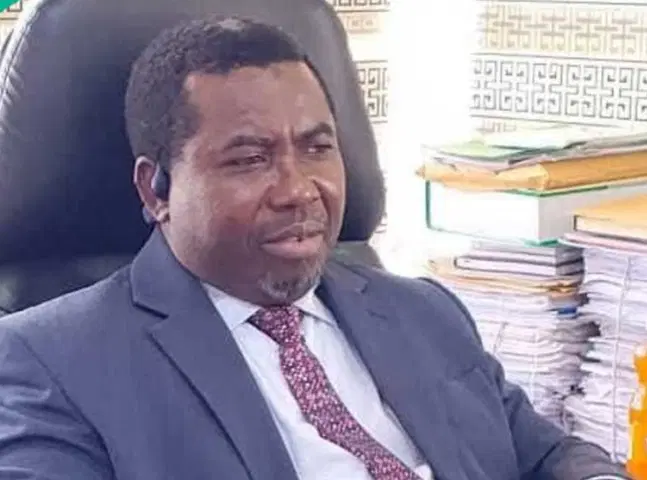
Written by Ibrahim Hassan-Wuyo
The Supreme Council for Shari’ah in Nigeria (SCSN) has called for the removal of Professor Joash Amupitan, the Chairman of the Independent National Electoral Commission (INEC). The Christian Association of Nigeria (CAN) in the 19 Northern states and the Federal Capital Territory (FCT) has rejected the demand, calling it an attempt to politicize religion and weaken a crucial national institution.
Concerned by a legal brief in which the INEC chairman allegedly confirmed allegations of Christian persecution in Nigeria, the Shari’ah Council had earlier demanded the chairman’s immediate dismissal and prosecution.
In response, Northern CAN’s Chairman, Rev. Joseph John Hayab, and Secretary-General, Bishop Mohammed Naga, jointly signed a statement on Thursday in which the Christian organization questioned the demand’s motivation, asking who was funding it and why such interests were being pursued under the auspices of a religious organization.
Northern CAN warned that it was risky and could exacerbate sectarian tensions to use religion as a justification for doubting the integrity of public office holders.
The statement claims that Professor Amupitan, like all Nigerians, has a constitutional right to freedom of religion and that voicing concerns about difficulties in one’s faith does not always equate to prejudice or disqualification from public service.
The association asked Nigerians to prioritize competence, integrity, and national interest over religious affiliation, pointing out that a number of Muslims had held critical national positions in the past while being openly linked to religious causes without experiencing the same scrutiny.
Northern CAN also voiced worry that the dispute supports long-standing allegations of discrimination against Christians based on their religion, especially when it comes to appointments to important national positions. Recalling that the two most recent INEC chairs were Muslims from Northern Nigeria, it cautioned against stories implying that only followers of a specific religion should be able to hold positions of leadership within the electoral organization.
The statement stated that competence, not faith, should continue to be the standard for public service and that “anyone hiding under the guise of a religious council to demand the removal of the INEC chairman for political or sectarian reasons should come out openly.”
The Christian body commended President Bola Ahmed Tinubu for appointing a Christian as INEC chairman, describing the decision as a demonstration of inclusivity and national unity. It also cited the precedent set by former President Goodluck Jonathan, who, in spite of political pressure at the time, kept a Muslim from the north as head of INEC.
Northern CAN cautioned that religious forums should not be used as a cover for political purposes or to intimidate public officials, and it encouraged the Shari’ah Council to explicitly identify any person or organization behind the campaign against the INEC chairman.
Additionally, the group advised Professor Amupitan to stay focused on his constitutional mission to hold free, fair, and credible elections rather than getting sidetracked by the controversy.
The statement went on, “He should focus on doing what is right for Nigerians and not be drawn into distractions capable of undermining public confidence in the electoral process.”
Ahead of the general election in 2027, Northern CAN expressed concerns about what it called “emerging signals of a coordinated political agenda.” It referenced recent remarks made by Hannatu Musawa, Minister of Culture, Tourism, and Creative Economy, which implied that the All Progressives Congress (APC) would lose the election if it drops its Northern Muslim-Muslim ticket for President Bola Ahmed Tinubu’s reelection.
things to think about.
Any attempt to restrict political leadership to a specific religion or geographic area, the group said, might widen rifts and jeopardize the nation’s precarious unity.