



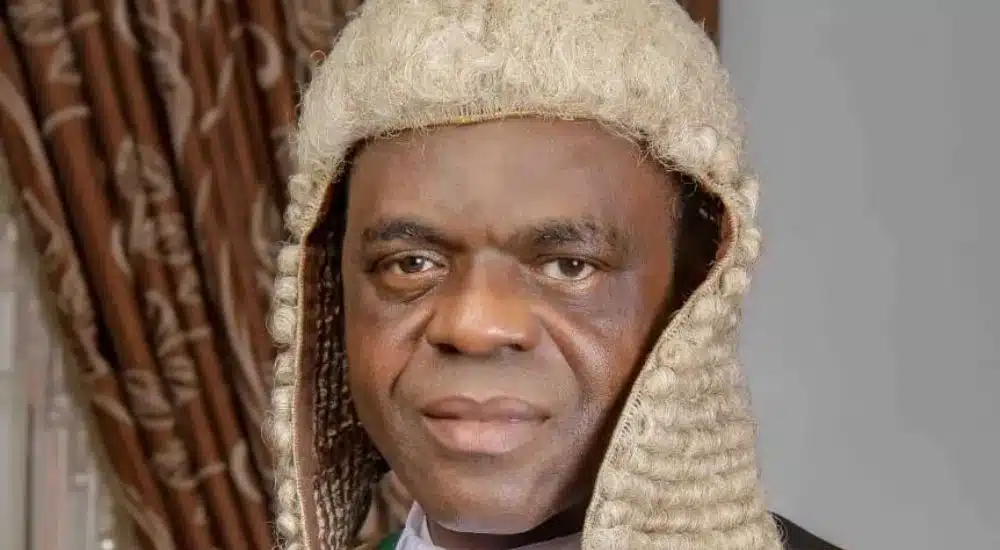
According to an investigation, John Terhemba Tsoho, the Chief Judge of the Federal High Court, filed an asset disclosure form to the Code of Conduct Bureau in April 2024 that allegedly omitted information on several bank accounts.
In the paper he filled out on April 29, 2024, Justice Tsoho allegedly left out a number of naira and domiciliary accounts, according to documents examined by the investigators.
Three accounts domiciled with United Bank for Africa and another with Access Bank were allegedly not revealed in the filing, according to Premium Times.
Public officials are expected to disclose all assets, including bank accounts and the money kept in them, in accordance with Nigeria’s Code of Conduct. False statements or non-disclosure are illegal and can result in penalties, including termination from office.
Every public official is required under Section 15 of the Code of Conduct Bureau and Tribunal Act to declare all properties, assets, and liabilities as soon as they take office and at predetermined times after that.
Additionally, according to the law, any false statement will be considered a violation of the Act, and assets obtained after declaration that cannot be reasonably linked to legitimate income may be assumed to have been obtained illegally unless proven otherwise.
A public official may be removed from office, disqualified from holding public office for up to ten years, and have their wrongly declared assets forfeited if found guilty by the Code of Conduct Tribunal. The Court of Appeal may hear appeals of the tribunal’s decisions.
Calls and mails from the aforementioned platform asking Justice Tsoho to clarify the accusations were not answered.
The case of former Nigerian Chief Justice Walter Onnoghen, who was found guilty and removed from office by the Code of Conduct Tribunal on April 18, 2019, for failing to register certain bank accounts, would be comparable to a conviction for false asset declaration.
The tribunal had mandated that Onnoghen’s five bank accounts be forfeited. But after a compromise between him and the Federal Government, the Court of Appeal overturned the conviction on November 4, 2024.
On July 26, 2019, Tanko Muhammad, the Chief Justice of Nigeria at the time, named Justice Tsoho as Acting Chief Judge of the Federal High Court. He was recommended for a substantive appointment by the National Judicial Council on October 23, 2019, and it was accepted by President Muhammadu Buhari on October 30, 2019, and confirmed by the Senate on November 5, 2019.
He was born on June 24, 1959, in Mbaduku, Benue State’s Vandeikya Local Government Area. He attended the Nigerian Law School, earned an LLB from the University of Lagos in 1984, and was admitted to the Nigerian Bar in 1985.
Before taking the oath of office as a judge of the Federal High Court in 1998, he began his career in the Benue State judiciary in 1986 and advanced from Magistrate Grade II to Chief Magistrate Grade I. In 2019, he was promoted to Chief Judge.
The accusations coincide with increased judicial scrutiny. The Chief Justice of Nigeria, Kudirat Kekere-Ekun, is the chair of the National Judicial Council, which recently started looking into petitions involving certain high judicial personnel, including allegations of fake asset declarations.
According to those who spoke to Premium Times, “damning and disturbing petitions” against nameless judges set off the investigation.
As of this writing, it is unknown if the accusations against Justice Tsoho would result in formal Code of Conduct Bureau investigations or tribunal procedures.