



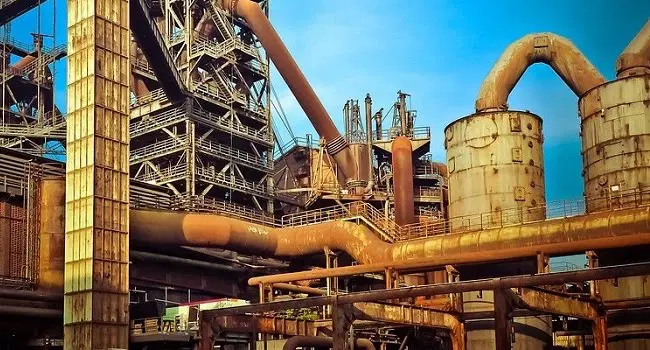
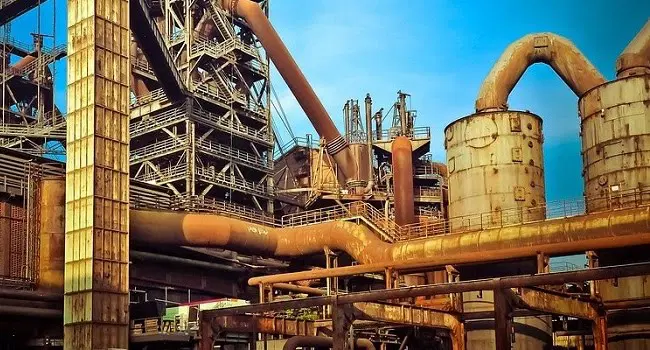
The budgetary allocation for the non-operational Ajaokuta Steel Company Limited (ASCL) in 2026 has continued to elicit conflicting responses from stakeholders.
In Abuja on Monday, they were interviewed by the News Agency of Nigeria (NAN).
Founded in 1979, the ASCL is a vital resource designed to propel Nigeria’s modernization.
According to NAN, ASCL received N6.69 billion in the 2026 Appropriations Bill, which is 4.90 percent less than the N7.03 billion allotted in 2025.
The budget includes N410.8 million for capital projects, N233.6 million for overhead, and N6.04 billion for staff costs.
Some stakeholders voiced concern that the allocation would be mishandled, while others praised the government’s attempts to revive the business, especially in accordance with President Bola Tinubu’s objective for economic diversification.
Despite ongoing budgetary allocations for the steel company’s recovery, Mr. Philip Jakpor, Executive Director of Renevyln Development Initiative (RDI), voiced worries about reports of its current situation.
Jakpor said that previous administrations had frequently accessed funding through ASCL without elevating its standing.
“It appears that some people in every administration have turned it into a cash cow; they invest billions of naira in its rehabilitation, but the mill never operates.”
He stated, “Therefore, we are not shocked that this administration has allocated N6.69 billion for it in the 2026 Appropriation.”
The Campaign for Democracy, Human Rights Advocacy, and Civil Society of Nigeria’s North Central Zone Chairman, Dr. Abdullahi Jabi, emphasized the significance of discipline for efficient budget execution.
He claimed that Nigeria’s industrialization efforts, which he characterized as essential to the growth of the steel industry, are undermined by budget “somersaults.”
According to him, crucial industries like the steel sector ought to be given top priority, and experts and specialized labor should be hired to strengthen the economy in the face of present difficulties.
“People should be impacted by critical areas beyond the signing of Memorandums of Understanding without any tangible results.”
“As promised during the electioneering campaign, we require a paradigm shift,” he stated.
According to Dr. Emmanuel Shuiabu, a former resident of ASCL, who resided in Ajaokuta from 1982 to 2002, the steel mill used to be Nigeria’s biggest employer, with over 10,000 direct jobs.
According to Shuiabu, the town had no outages from 1987 to 1989 and the company’s Thermal Power Plant and Turbo Blower Station used to produce electricity at full capacity.
Because ASCL is Africa’s largest steel factory, he said, “the challenge with government is the lip service they pay to some things that are meant to drive industrialization in Africa.”
He said that because of their experience, professionals who have worked at ASCL should be involved in efforts to revive it, even if it means hiring people who retired from the factory.
Not all allocations were often disclosed throughout implementation, according to Shuiabu, another finance expert, despite stakeholders’ worries about the plant’s growing costs.
NAN remembers that Prince Shuaibu Audu, the Minister of Steel Development, stated in his New Year’s speech that the ministry kept the momentum for reform going by making wise use of the 2024 appropriation, notwithstanding the non-release of 2025 budget monies.
Only maintenance work was being done at the factory, according to a public analyst from Lokoja who wished to remain anonymous. He said he was frequently disappointed while trying to confirm fresh advances there.
“All they are doing is keeping the place up so it doesn’t collapse. It’s similar to keeping the brain alive in case the body awakens. The Jos Steel Rolling Mill is in a similar predicament, he added.
In contrast to the thriving socioeconomic activities that were once observed in the area, Mrs. Victoria Ola, a former employee of the firm who resided in the quarters, claimed that the villages surrounding the steel industry had become a shell of their former selves.
Ola, however, asked Nigerians to be patient with the government while it worked to revive the facility and lessen the country’s excessive reliance on oil.
According to a government official who wished to remain anonymous, capital projects received only 6.1% of the budget, which is insufficient to bring about meaningful change in the near future, while the majority of funds were used for human expenditures to maintain the facility.
According to Audu, the ministry signed a Memorandum of Understanding with the Federal Ministry of Defense to construct a military industrial complex within the Ajaokuta Steel Company and to produce military hardware locally.
He claimed that the Defense Industries Corporation of Nigeria will work with them to accomplish this.
The minister stated that it maintained its reform momentum by carefully implementing important elements of the 2024 Appropriations Bill despite obstacles in 2025, including the non-release of funds for the implementation of the 2025 budget. (NAN)