



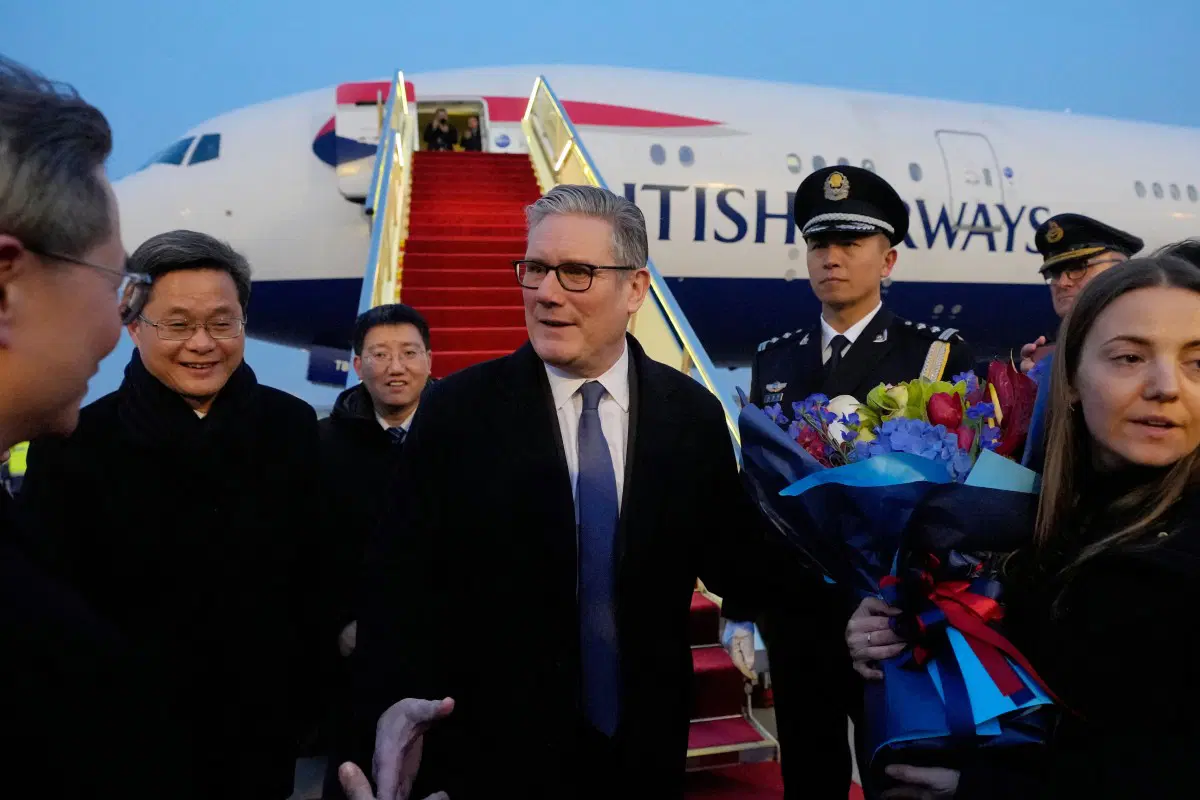

In an effort to mend long-strained ties, British Prime Minister Keir Starmer traveled to Beijing on Wednesday to meet with Chinese President Xi Jinping.
The UK prime minister’s first trip to China since 2018 comes after a number of Western leaders have been courting Beijing in recent weeks, turning away from the volatile United States.
Starmer will later make a quick stop in Japan to meet with Prime Minister Sanae Takaichi. He is also scheduled to visit Shanghai on Friday.
At a time when President Donald Trump’s policies have shaken long-standing relations between Washington and its Western allies, Xi sees the trip as a chance to demonstrate that Beijing can be a trustworthy ally.
Starmer, whose popularity is at an all-time low, expects that the visit would help Britain’s struggling economy.
Downing Street has praised the trip as an opportunity to improve trade and investment relations while bringing up difficult topics like human rights and national security.
On Thursday, Starmer will have lunch with Xi before meeting Premier Li Qiang.
This trip to China is “going to be a really important trip for us,” the British leader declared on Wednesday, promising to achieve “some real progress.”
On the plane to China, Starmer told reporters that there are “opportunities” to strengthen bilateral ties.
“When it comes to China, it doesn’t make sense to stick our heads in the ground and bury our heads in the sand; it’s in our interests to engage and not compromise on national security,” he continued.
During a news briefing on Wednesday, Guo Jiakun, a spokeswoman for the foreign ministry, reaffirmed that China “is willing to take this visit as an opportunity to enhance political mutual trust.”
Following visits by French President Emmanuel Macron and Canadian Prime Minister Mark Carney, Starmer is the most recent Western leader to be hosted by Beijing in recent months.
In the face of Trump’s attempts to establish a new international organization with his “Board of Peace” and his threats to levy tariffs on Canada for entering into a trade agreement with China, Beijing has been reassuring visiting leaders of its support for the UN.
Reset ties: After Beijing passed a broad national security ordinance on Hong Kong in 2020, significantly restricting liberties in the former British territory, relations between the UK and China fell apart.
Since then, they have deteriorated much further as both governments have accused one another of snooping.
However, Starmer quickly refuted new allegations of Chinese espionage after the Telegraph newspaper revealed on Monday that China has been hacking senior Downing Street officials’ cell phones for a number of years.
“There is no proof of that. As you could anticipate, we have strong plans and security procedures in place,” he told reporters on Wednesday.
Starmer has worked hard to mend relations with the second-largest economy in the world and Britain’s third-largest trading partner since taking over in 2024.
He will be accompanied in China by about sixty corporate executives from the automotive, pharmaceutical, finance, and other industries, as well as cultural figures, as he attempts to strike a balance between luring crucial investment and projecting a tough stance on national security issues.
On the fringes of the November 2024 G20 summit in Brazil, the Labour leader also had a conversation with Xi.
Jimmy Lai
Jimmy Lai, a 78-year-old British national who is facing years in prison after being convicted guilty of collusion charges in December, is a Hong Kong media mogul and supporter of democracy. The prime minister is also anticipated to bring up his case.
In response to questions from reporters regarding his intentions to talk about Lai’s case, Starmer stated that he was speaking with Beijing in order to make sure that “issues where we disagree can be discussed.”
Starmer, who has been criticized by the Conservative opposition of being too kind toward Beijing, continued, “You know my practice, which is to raise issues that need to be raised.”
In a letter, Reporters Without Borders asked Starmer to ensure Lai’s release while he was there.
After approving controversial plans this month for a new Chinese mega-embassy in London, which critics claim may be used to spy on and harass dissidents, the British government has also encountered strong local opposition.
Chinese officials took issue with Starmer’s admission at the end of last year that China constituted a “national security threat” to the United Kingdom.
The nations also disagree on important topics, such as China’s alleged violations of human rights and its strong relations to Russian President Vladimir Putin during the conflict in Ukraine.