




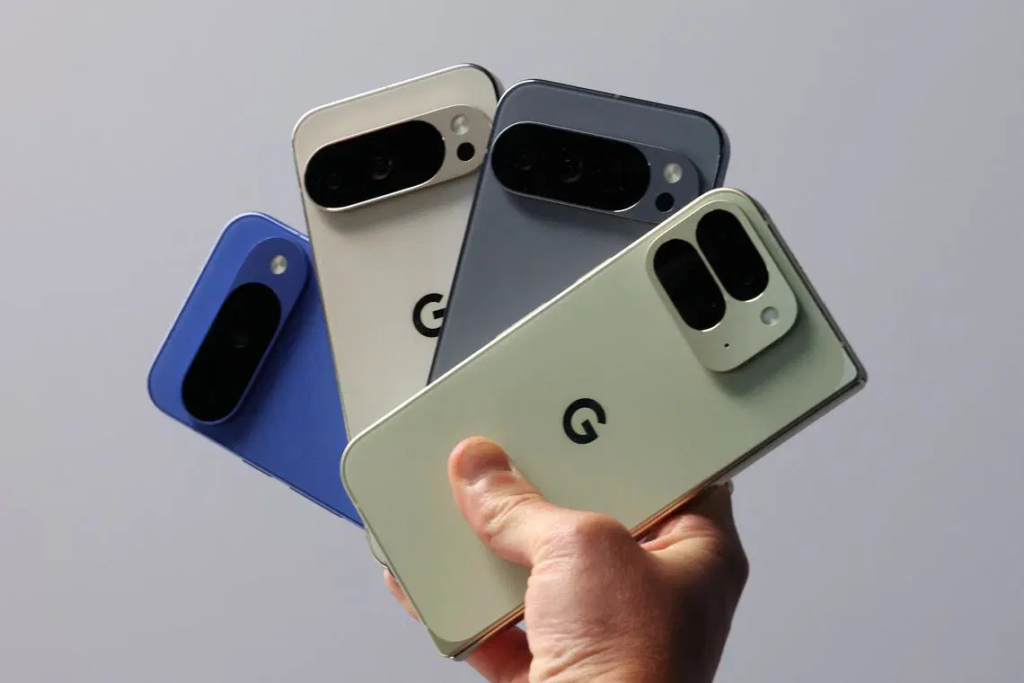
Although the Pixel 10 is the phone that Android enthusiasts most strongly identify with Google’s vision for the platform, it is no longer the best in terms of performance. The Pixel 10 finds it difficult to compete with competing Android flagships that are based on more aggressive hardware, even before taking into consideration Apple’s iPhone 17 Pro Max.
Google’s Tensor G5 processor is at the core of the problem. Tensor chips have continuously fallen short of Qualcomm’s top-tier hardware in areas like sustained CPU performance, graphics power, and thermal efficiency, despite their superiority at on-device AI tasks. The Pixel 10 was already lagging behind phones released months earlier when it debuted in August of last year, and the difference has only gotten bigger as we approach early 2026.
The five Android smartphones listed below operate noticeably better than the Pixel 10. This comparison ignores price and software preferences and only considers power-related hardware, such as processor power, RAM capacity, display capability, battery technology, and thermal performance.
These phones are worth serious consideration if you value next-generation hardware, gaming, speed, and multitasking more than Google’s AI-first strategy.
The Samsung Galaxy S25
About six months prior to the release of the Pixel 10, Samsung’s Galaxy S25 series made its debut at the start of 2025. Even with that advantage, its performance still surpasses that of Google’s flagship.
The Qualcomm Snapdragon 8 Elite, which is thought to be the most potent smartphone processor of 2025, powers every model in the Galaxy S25 family, from the base model to the S25 Ultra. The Snapdragon 8 Elite outperforms the Tensor G5 in almost every category, according to benchmark tests released by Android Central. The Pixel 10 only has an advantage in workloads that are AI-focused.
That outcome is not unexpected. Google prioritized machine learning and AI acceleration when designing Tensor G5, frequently at the expense of graphics and long-term performance. The Galaxy S25 is just a more powerful device for demanding productivity workflows, heavy multitasking, and gaming.
Since both phones come with 12 GB of RAM, the main distinction is chipset performance. Even Samsung’s Ultra model is limited to 12 GB, which is an odd restriction that might be significant for people who depend significantly on memory-intensive programs, even though the Pixel 10 Pro has a 16 GB option.
The OnePlus 15
The competition becomes less subtle after this. The Snapdragon 8 Gen 5, the successor to the already-dominant Snapdragon 8 Elite, powers the other phones on this list, further lagging behind the Pixel 10.
The OnePlus 15 is a testament to the company’s progress since its “flagship killer” beginnings. These days, OnePlus produces complete high-end phones that directly compete with Xiaomi, Samsung, and Apple based solely on performance.
The OnePlus 15 can be set up with up to 16 GB of RAM, which is more than the 12 GB of RAM found in the regular Pixel 10 and matches the Pixel 10 Pro. However, the true division occurs elsewhere.
The Pixel 10’s 4,870 mAh lithium-ion battery is dwarfed by its enormous 7,300 mAh silicon-carbon battery. Higher energy density is made possible by silicon-carbon technology, which Chinese manufacturers have adopted significantly more quickly than Google. Better endurance without gaining weight or bulk is the eventual consequence.
OnePlus is also favored by the display specs. With a resolution of 2,772 × 1,272 and a refresh rate of 165 Hz, the OnePlus 15 boasts an advanced AMOLED display with HDR10+. The Pixel 10’s OLED screen has a lower resolution and a maximum frequency of 120 Hz, but it has a higher peak brightness of 3,000 nits than OnePlus’s 1,800 nits.
The Xiaomi 17 Pro Max
When the Xiaomi 17 Pro Max debuted late last year, it attracted attention for more reasons than just how much it resembled Apple’s iPhone 17 Pro Max. It has hardware that easily outperforms Google’s Pixel 10.
The 17 Pro Max, which has up to 16 GB of RAM and is powered by the Snapdragon 8 Gen 5, takes the lead in performance right away. Additionally, its triple 50 MP camera system surpasses the Pixel’s mixed-sensor configuration, which uses telephoto and ultra-wide lenses with lower resolution.
Another clear victory is battery technology. The Pixel 10’s sub-5,000 mAh battery seems antiquated in contrast to Xiaomi’s massive 7,500 mAh silicon-carbon battery seen in the 17 Pro Max.
However, Xiaomi’s most audacious move is the addition of a secondary 2.9-inch AMOLED display to the rear camera module. In addition to displaying widgets, notifications, and animated companions, this screen can serve as a selfie viewfinder. It’s a feature that the Pixel 10 just lacks, whether it’s a novelty or a must-have.
Honor Magic8 Pro
The Honor Magic8 Pro is an excellent illustration of how companies may differentiate themselves even when utilizing the same top-tier chipset in the fiercely competitive Android flagship market outside of the United States.
In benchmark tests provided by Phone Arena, the Magic8 Pro, which debuted in October 2025, handily outperformed the Pixel 10 Pro XL thanks to its Snapdragon 8 Gen 5 and up to 16 GB of RAM. However, the display and charging technology are where it truly shines.
Its 6.71-inch LTPO OLED panel is compatible with HDR Vivid, Dolby Vision, and a refresh rate of 120 Hz. However, its remarkable 6,000-nit peak brightness—double that of the Pixel 10—is its most notable feature. Eye strain is lessened by high PWM dimming, particularly at lower light levels.
The battery’s capacity is likewise remarkable. The Chinese model has a 7,200 mAh battery with 120W charging, whilst the worldwide version has a 7,100 mAh battery with 100W fast charging. The difference is striking when compared to the 30W charging speed of the Pixel 10.
During hands-on testing at CES 2026, Honor’s camera hardware also wowed, with its 50 MP primary sensor and 200 MP telephoto producing exceptional results in real-world shooting circumstances.
RedMagic 11 Pro
The RedMagic 11 Pro disproves the notion that the performance of contemporary smartphones has reached its maximum.
The RedMagic 11 Pro is the first liquid-cooled smartphone in history, and it was created by Nubia, a ZTE subsidiary that specializes in gaming electronics. The Snapdragon 8 Gen 5 can maintain higher performance levels without throttling thanks to this sophisticated cooling technology, something that conventional cooling methods find difficult to accomplish.
The outcomes are indisputable. It beat the OnePlus 15 and the Galaxy S25 Ultra in single- and multi-core benchmarks, earning the title of fastest smartphone ever tested by Linus Tech Tips. In several performance indicators, GSMArena testing revealed that it scored almost four times higher than the Pixel 10.
In addition to its sheer CPU power, the RedMagic 11 Pro has a maximum RAM capacity of 24 GB, which is twice that of the Pixel 10. It has an enormous 7,500 mAh silicon-carbon battery, a headphone connection, a 144 Hz AMOLED display, and quicker USB-C speeds.
In spite of this, it still costs less than $1,000, which is less than many high-end flagships, while the Pixel 10’s top-tier setup costs $900.