



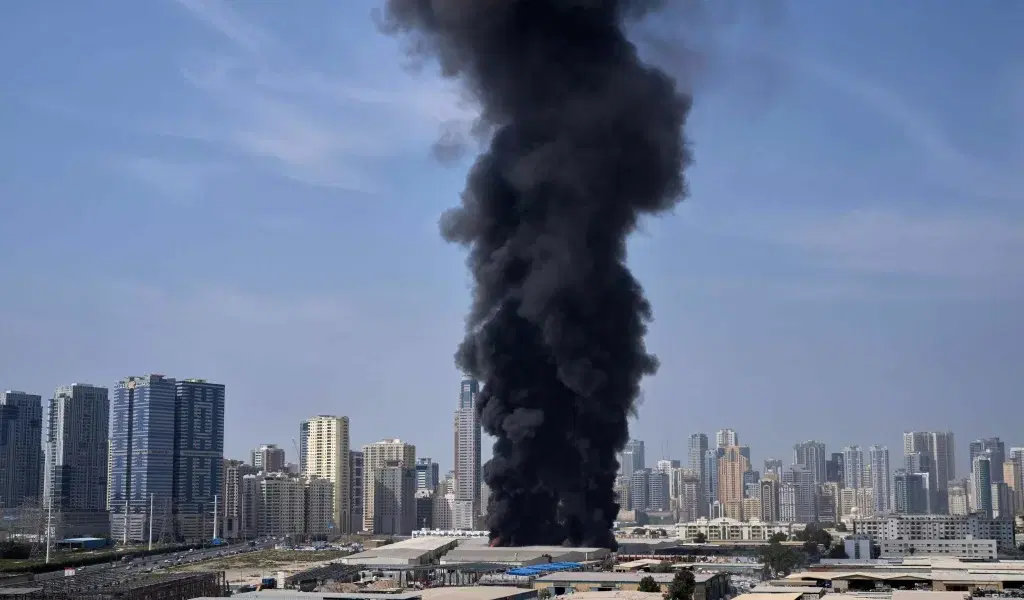
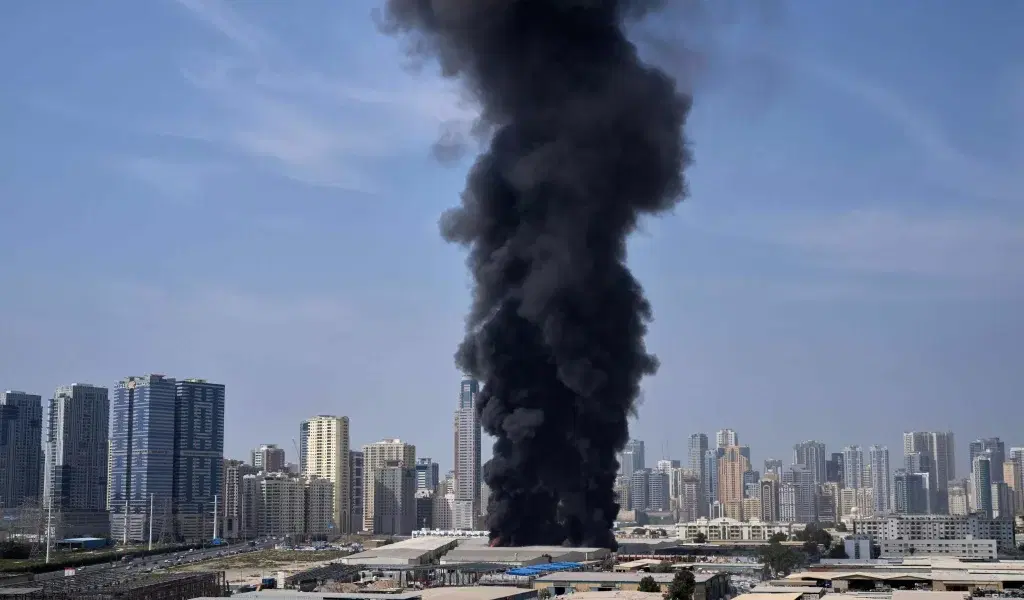
As Iran retaliated against diplomatic and economic sites throughout the Middle East and Washington issued a warning to its nationals to leave the whole region, drones attacked the US embassy in Riyadh on Tuesday.
AFP reporters in the Saudi capital observed smoke damage on the embassy’s walls and top four days after US and Israeli missiles killed Iran’s supreme commander and started a regional conflict.
Everyone entering the diplomatic sector was having their IDs checked by Saudi police, who were swarming the area. Numerous highways, including those leading to the US embassy, were closed.
As fighter planes soared over the Iranian capital and US President Donald Trump threatened to intensify the battle, Tehran was also rocked by powerful explosions throughout the night.
Due to “serious safety risks,” the US State Department advised “Americans to DEPART NOW” from all Middle Eastern nations and territories on Monday.
In the meantime, Israel claimed to be taking additional forward positions inside southern Lebanon following Hezbollah’s missile launch in support of Iran, which sparked an intense Israeli assault.
Israeli forces have been given permission “to advance and take control of additional strategic positions in Lebanon in order to prevent attacks on Israeli border communities,” according to Israeli Defense Minister Israel Katz.
Burn any ship: According to a Lebanese military source, the Lebanese army repositioned troops in the south after Israel’s “escalation.” Hezbollah said it had attacked three Israeli bases.
Iranian attacks continued to affect oil and gas infrastructure in Gulf towns and the Omani port of Duqm, and the benchmark Brent crude price surged once more as European markets opened.
Revolutionary Guards General Sardar Jabbari emphasized the threat the conflict poses to the world economy by declaring, “We will burn any ship that tries to pass through the Strait of Hormuz.”
Trump issued a warning in Washington that the strikes might go on for weeks or months.
“We have the capacity to go much longer than that, but from the start we projected four to five weeks,” Trump stated at the White House.
Trump, who ran on a platform of ending US involvement in conflicts, declined to rule out sending US ground forces to Iran “if they were necessary” in an earlier interview with the New York Post.
Additionally, Trump told NewsNation that Iran will “find out soon” how he intended to respond to the attack on the Riyadh embassy.
For the first time, the US president outlined the goals of the operation, which include eliminating Iran’s nuclear program, navy, and missiles as well as halting its backing for armed organizations around the region.
Notably, Trump’s objectives did not include overthrowing the Islamic republic, despite the fact that both he and Israeli Prime Minister Benjamin Netanyahu have called on the Iranian people to rebel.
Saudi Arabia claimed to have captured eight more drones in two cities, including the capital, on Tuesday. Saudi Arabia is home to one of the biggest oil refineries in the area, some of which have previously been shut down due to assaults.
However, two managed to get past air defenses and hit the US embassy, starting a fire.
According to the state’s media office, debris from downed drones started a fire at an oil complex in Fujairah, one of the United Arab Emirates. After the fire was contained, operations resumed.
“Imminent threat?” US Secretary of State Marco Rubio offered a startlingly different account of the conflict’s origins.
The United States, which had increased its forces in the Gulf to levels not seen since its invasion of Iraq in 2003, only launched an attack after discovering that its friend Israel was going to attack Iran, according to Washington’s senior diplomat.
According to Rubio, Trump chose to act “pre-emptively” alongside Israel because Iran was prepared to attack US personnel in the area in retaliation for Israel.
Before briefing Congress, Rubio told reporters, “The imminent threat was that we knew that if Iran was attacked — and we believed they would be attacked – that they would immediately come after us.”
Rival Democrats expressed incredulity, with Senator Mark Warner stating that it was “uncharted territory” for the US to intervene in response to Israel’s perceived threat.
“There was never any so-called Iranian ‘threat,'” Seyed Abbas Araghchi, Iran’s foreign minister, retorted.
He wrote on X, “Mr. Rubio acknowledged what we all knew: the US has entered a war of choice on behalf of Israel.”
Trump, who ran on a platform of ending US involvement in conflicts, declined to rule out sending US ground forces to Iran “if they were necessary” in an earlier interview with the New York Post.
Six US military personnel have been killed in the conflict thus far, according to US Central Command, and the death toll has been rapidly rising throughout the region.
Although AFP reporters have not been able to independently confirm tallies, Iranian media have reported hundreds of Iranian dead, including scores at a girl’s school.
On the third day of the conflict, 101 people were killed within Iran, including “85 civilian deaths and 11 military personnel killed,” according to the US-based Human Rights Activists News Agency (HRANA) on Tuesday.
Many Tehrani citizens were caught between hope that the government’s days might be coming to an end and terror of the explosions.
AFP reporters saw some residents getting ready to flee with their baggage.
In a voicemail to Europe, a 45-year-old lawyer stated, “Every time we hear the noises, we get scared for just a second, but we experience some joy and excitement every time we hear a hit.”