



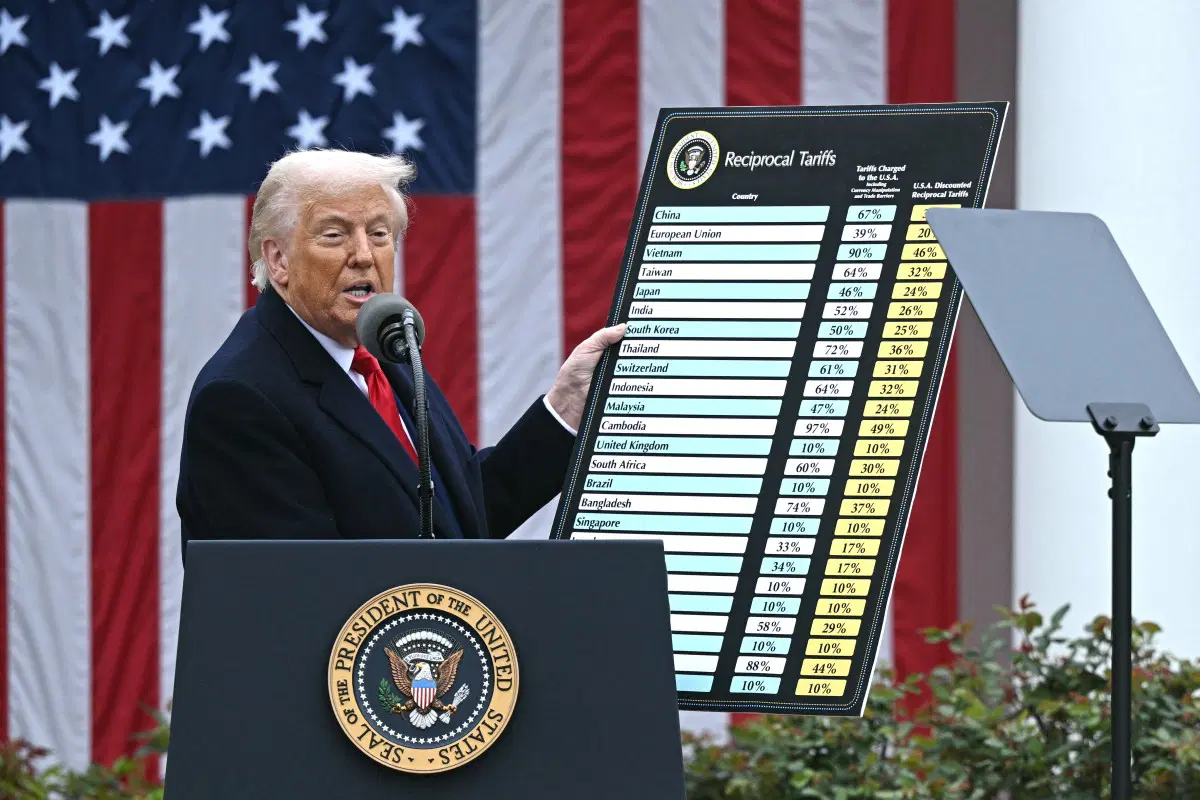

Tuesday saw the implementation of new US import tariffs as President Donald Trump attempted to restructure his trade policy following the Supreme Court’s decision to overturn a large portion of his international duties.
According to a White House statement released Friday, the new tariffs, which are initially set at 10 percent, are justified as a way “to deal with the large and serious United States balance-of-payments deficits.”
Since then, Trump has pledged to increase this percentage to 15%, with the US-Mexico-Canada trade agreement and imports subject to sector-specific inquiries likely to continue to be excluded.
In a rebuke of his flagship economic policy, the high court on Friday invalidated several of the US president’s broad and frequently capricious duties, prompting him to step up his efforts to impose tariffs on trading partners.
Although the decision lays the groundwork for a convoluted battle for refunds elsewhere, his sector-specific tariffs on products like steel and automobiles are still in place.
The new tax, which goes into effect on Tuesday, has a 150-day expiration date unless Congress decides to prolong it. It is generally regarded as a step toward more robust trade policy.
Additionally, US Customs and Border Protection has announced that it will cease collecting tariffs that the court has invalidated as of Tuesday.
Separately, it announced that the new 10-percent tariffs would be collected on Tuesday.
The conservative-majority court decided six to three that Trump had overreached himself by abruptly imposing tariffs on certain nations under a 1977 legislation.
According to the Tax Foundation’s vice president of federal tax policy, Erica York, Trump’s new tariff will be applied on $1.2 trillion in imports annually, or roughly 34% of all imported items.
“In 2025, the average tax increase per US household due to the Trump tariffs was $1,000,” she continued.
Trump’s new and current tariffs are still expected to “result in a household burden of $700 in 2026,” she claimed, despite the fact that his global tariffs imposed under the International Emergency Economic Powers Act were declared unlawful.
Wings clipped: On Monday, Trump asserted that the Supreme Court’s decision had granted him “far more powers and strength,” allowing him to “use licenses to do absolutely ‘terrible’ things to foreign countries.”
Former US trade official Wendy Cutler stated, “Now that his tariff wings have been clipped, Trump needs a new tool to express displeasure on actions by others.”
The Asia Society Policy Institute’s senior vice president, Cutler, continued, “threatening high licensing fees is an alternative, but it lacks the flair and quantitative nature of tariffs.”
In a warning to countries who recently signed trade agreements with Washington under the fear of duties, Trump also promised Monday to increase tariffs on those that decide to “play games” in response to the court ruling.
In an effort to appease and punish both friends and foes, Trump has levied different tariff rates on partners over the past year, occasionally altering them abruptly. In trade negotiations, he has leveraged this.
Despite the decision, US Trade Representative Jamieson Greer stated on CBS on Sunday that tariff accords are still in effect, saying, “We expect our partners to stand by them.”
However, for other nations, such as Australia and Britain, the feared 15 percent duty is higher than the 10 percent rate they were subjected to under the prior program. Cutler cautioned that Trump’s actions would make US allies even more disappointed. “They could increase their efforts to diversify away from the United States, but it is unlikely that they would retaliate,” she said.