



By Omeiza Ajayi, Victor Ahiuma-Young, and Henry Umoru
ABUJA— New information has surfaced on the Senate’s rejection of a plan to require the electronic transmission of election results in real time, ahead of the general election in 2027.
The proposal, which was an amendment to Clause 60(3) of the Electoral Act, 2022 (Repeal and Enactment) Bill, 2026 (SB. 903), aimed to require the Independent National Electoral Commission’s (INEC) presiding officers to upload polling unit results in real time to the INEC Result Viewing Portal (IReV).
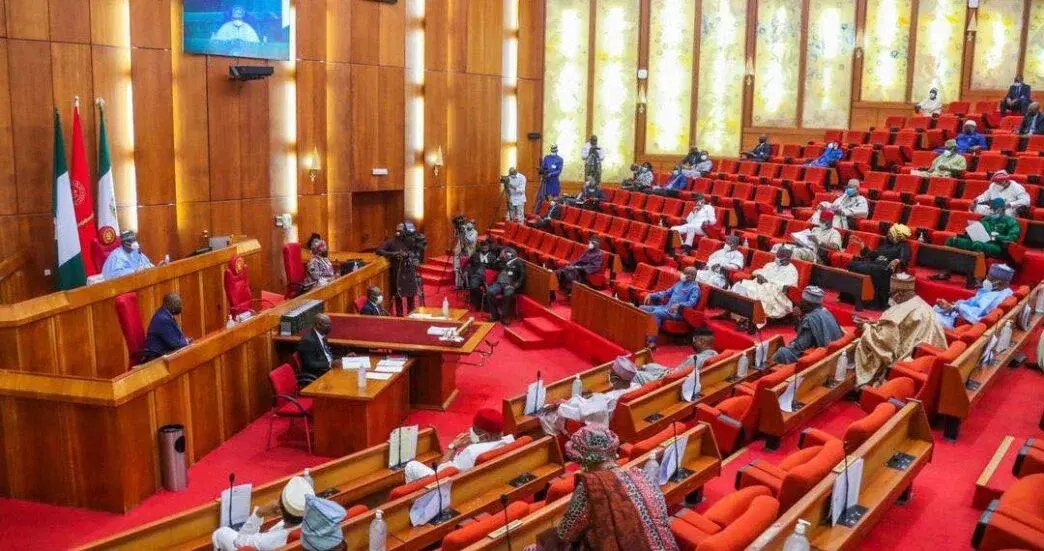
The 10th Senate, led by Senate President Senator Godswill Akpabio, rejected the proposal, which also sparked broader revisions on election schedules, electoral offense punishments, and voting technology.
The bill’s Section 60(3), which addresses the transmission of polling unit results, is at the heart of the dispute. The Senate Committee on Electoral Matters, led by Senator Simon Lalong (APC, Plateau South), proposed the measure.
According to sources who spoke to Vanguard, the Senate first worked on a version of the committee’s report that kept real-time electronic transmission as it was being considered clause by clause.
However, the Senate’s final version was changed at the last minute to remove the clause after hours of deliberations and as plenary continued late into the evening.
The Senate had already approved electronic broadcasting in a private session with a resounding majority, according to sources.
After more than a year of consultations, it was also approved by an ad hoc committee led by Senator Niyi Adegbonmire of the APC (Ondo Central).
Through zonal public hearings and joint sessions with INEC, civil society organizations, and stakeholders, the Adegbonmire committee reportedly came to the conclusion that in order to prevent the legal controversies that followed the general elections in 2023, electronic transmission needs to be explicitly legalized.
“The Presiding Officer shall electronically transmit the results from each polling unit to the IREV portal in real time and such transmission shall be made after the prescribed Form EC8A has been signed and stamped by the Presiding Officer and/or countersigned by the candidates or polling agents available at the polling unit,” according to Clause 60(3) on page 45 of the Senate Committee on Electoral Matters report.
According to a source, many senators believed the section would pass easily because of previous resolutions.
The insider claimed that three senior Southern senators allegedly stepped in and added, “That’s when the unexpected happened.”
The source said that the senators went to the Senate President and pleaded with him to keep the 2022 Electoral Act clause in place.
According to reports, Akpabio reaffirmed the current rule, which prohibits electronic transmission until after votes have been tabulated and made public at polling places.
Despite the fact that there was no new debate on the floor, the word “transfer” was used in accordance with the 2022 Act in place of “transmission.”
The amendment that was rejected would have required that results be uploaded to IReV in real time as soon as Form EC8A was completed.
“The Presiding Officer shall transfer the results, including the total number of accredited voters and the results of the ballot, in a manner as prescribed by the commission,” reads the adopted clause.
The Senate gives in to pressure and will have an emergency meeting tomorrow rather than February 24.
However, the Senate has been forced to call another emergency plenary session tomorrow, February 10, 2026, at 12:00 noon, in response to the intense criticism that followed its rejection of a proposed amendment to Clause 60, Subsection 3 of the bill, which sought to require the real-time electronic transmission of election results.
The plenary was postponed until February 24 on Wednesday.
An official notification dated February 8, 2026, issued by Senate Clerk Emmanuel Odo, on behalf of Senate President Godswill Akpabio, officially announced the new development to reassemble tomorrow.
“I am directed by President of the Senate, Distinguished Senator Godswill Obot Akpabio, to inform all senators of the Federal Republic of Nigeria that an emergency sitting of the Senate has been scheduled as follows,” the senators’ notice, which was sighted yesterday, stated. Date: February 10, 2026, Tuesday. It is 12:00 p.m.
Senate Chamber is the location. We respectfully ask that senators take notice of this urgent meeting date and show up. We sincerely apologize for any trouble this will give the senators.
The timing definitely suggests a connection to the enormous public uproar surrounding the Senate’s treatment of important sections of the Electoral Act amendment, particularly Section 60(3), even though the official announcement did not specify the reason for the extraordinary session.
Prior to the final consideration of the ¦58.47 trillion 2026 Appropriation Bill, which is set for March 17, the Senate adjourned plenary last week following the passage of the Electoral Act (Amendment) Bill, 2026, to enable lawmakers to take part in ongoing budget defense sessions by ministries, departments, and agencies, or MDAs.
Recall that the Senate, led by Akpabio, adopted a motion to reject the proposed Section 60(3) during the clause-by-clause consideration of the electoral bill. The motion was proposed by Senate Chief Whip Tahir Monguno of the APC, Borno North, and seconded by Deputy Senate President Barau Jibrin of the APC, Kano North.
The proposal that was rejected aimed to mandate that election results be transmitted electronically in real-time from polling places to the INEC Result Viewing (IReV) portal. It suggested that:
“After the presiding officer has signed and stamped the required Form EC8A and/or candidates or polling unit agents have countersigned it, if available, the presiding officer will electronically transmit the results from each polling unit to the IReV portal in real time.”
Instead, the Senate kept Section 60(5) of the Electoral Act, 2022, which states.
According to parliamentary sources, in order to legitimize the decisions made, the Senate needs to meet again to confirm the votes and procedures.
They contended that this would allow the conference committee to operate and clear whether senators embraced “transfer” or “electronic transmission.”
The conference committee that Akpabio established to harmonize the measure with the House of Representatives cannot begin work unless the votes and proceedings are approved.
Orji Uzor Kalu, APC, Abia North; Abba Moro, PDP, Benue South; Asuquo Ekpenyong, APC, Cross River South; Aminu Iya Abbas, Adamawa; Tokunbo Abiru, APC, Lagos East; Asuquo Adegbonmire, APC, Ondo Central; Tahir Monguno, APC, Borno North; Adamu Aliero, APC, Kebbi Central; and Senator Simon Lalong, the conference committee’s chairman.
In addition to electronic transmission, the Senate significantly altered other bill provisions.
It eliminated harsher sanctions for purchasing and selling voter cards, which included fines of between N500,000 and N5 million as well as a 10-year ban from running for office.
Under revised Clause 28, the Senate shortened the time frame for INEC’s election notification from 360 to 180 days.
Additionally, it shortened Clause 29’s 180-day deadline for political parties to submit their lists of candidates to 90 days.
The Senate rejected electronically generated voter identification and kept the Permanent Voter Card (PVC) as the exclusive form of identification at voting places under Clause 47, replacing smart card readers with the Bimodal Voter Accreditation System (BVAS).
Due to worries that it may clutter the courts, Clause 142, which attempted to simplify the proving of non-compliance in election petitions by depending on documented evidence, was also knocked out.
2027 polling might not be ruined by delay—NBA
In the meantime, the Senate’s tardiness in completing the Electoral Act Amendment Bill has drawn criticism from the Nigerian Bar Association, or NBA.
While the Bar was concerned about the National Assembly’s speed, NBA President Mr. Afam Osigwe, SAN, stated that if INEC and stakeholders cooperated with the current legal framework, the postponement would not necessarily prevent the 2027 general elections.
“The actual process hasn’t actually begun yet. However, it will be preferable if those adjustments are introduced and increase trust, Osigwe told Vanguard.
Noting that technical concerns, such result transmission, only arise on election day, he counseled INEC to proceed with preparations in accordance with the current legislation.
Citing court interpretations of the 2022 Electoral Act, he stated, “You can pass the best laws, and if the judicial interpretation is anything but progressive, we have still not achieved anything.”
Civil society leader Mr. Clement Nwankwo also responded, urging INEC to promptly publish the notice for the 2027 elections in accordance with the current Electoral Act, which mandates 360 days’ notice.
“What I’m saying is that INEC should go ahead and announce the notice for elections in 2027 using our current Electoral Act,” he stated.
By allegedly changing the agreed-upon version of the bill, the Senate reportedly undermined national consensus, according to Nwankwo, Executive Director of the Policy and Legal Advocacy Centre, or PLAC.
He warned that executive session secrecy had led to a “legislative ambush,” saying on Channels Television that “the Electoral Act is not the personal property of anybody; it is a national property.”
He revealed that results must be delivered to IReV electronically in real time, as agreed upon by a bipartisan committee comprising the Senate, House of Representatives, INEC, and judicial experts.
“Nigeria has some of the most costly elections in the world. Nwankwo warned that further manipulation of legislative outcomes might undermine public faith and stoke discontent, saying, “You can’t spend billions on BVAS and then shortchange Nigerians on its use.”
Due to election uncertainties, the NLC threatens widespread boycotts and actions.
The Senate’s amendment to the 2022 Electoral Act, specifically regarding the real-time electronic transmission of election results, has caused confusion and contradictions, according to the Nigeria Labour Congress (NLC), which has threatened mass action and a potential nationwide boycott of future elections.
The NLC raised doubts about the legitimacy of the general elections in 2027, accusing the Senate of eroding public confidence in the electoral process and cautioning that if real-time electronic results transmission is not explicitly required, the country may face yet another electoral crisis.
“NLC expresses deep concern over the confusion and contradictory narratives emerging from the Senate regarding the amendment to the 2022 Electoral Act, particularly on electronic transmission of results,” the NLC stated in a statement issued by President Joe Ajaero.
This ambiguity seriously jeopardizes our democracy and erodes public confidence. The people of Nigeria are entitled to an open and transparent electoral process in which their votes are not only counted but also seen.
We implore the Senate to give a prompt, authoritative, and clear explanation of its actions and conclusions. According to public records, the current discretionary provision was kept in place, and the suggested modification to require INEC to submit results electronically in real-time was not enacted.
This has caused anxiety across the country, and further explanations have only made matters more confusing. Such legal uncertainty mirrors previous disputes that have caused national pain and runs the risk of institutionalizing doubt at the core of our democratic integrity at a crucial juncture, following the 2023 elections.
NLC hence wants transparency and clarity right away. The full wording and justification of the passed measures must be clarified by the Senate in a definitive declaration.
The leadership of the National Assembly must also guarantee that the final law with unambiguous contents is the result of the harmonization process. Any uncertainty in the findings’ transmission and compilation is detrimental to our democracy.
We urge the Senate to make sure that its procedures are open and its conclusions are unambiguous in order to rebuild parliamentary trust. The new Act must clearly require INEC to electronically communicate and compile polling unit results in real time. Confidence, not uncertainty, must be the foundation of the 2027 election campaign.
Nigerian citizens and workers are keeping a careful eye on everything. The NLC is promoting integrity and clarity within its networks. We will not tolerate another betrayal of Nigerians’ confidence or a compromise in the clarity of our voting laws.
If real-time electronic transmission is not included, there will be widespread protests prior to, during, and following the election, or the election will be boycotted entirely.
Our country must decide to follow the road of integrity and clarity. We must steer clear of the same misunderstanding that followed the elections in 2023. You can never beat a united people! “United workers can never be defeated!”